What is an MEM Degree?

What is engineering management?

A Master of Engineering Management, also known as an MEM degree or an MSEM degree depending on the institution, is a graduate degree that combines the technical skills of engineering with the business knowledge needed to lead an organization successfully. This is a degree for individuals who already hold a bachelor’s degree, preferably in engineering or an engineering-related field of study and are ready to take their education and career to the next level. An MEM degree is often a requirement for individuals who are pursuing management or executive-level roles within engineering or manufacturing companies or public agencies.

The fully online Master of Engineering Management program at The Ohio State University, prepares you to advance to management roles or leadership positions within the engineering industry. In this 100% online master’s program, you will learn new engineering management and business skills while better understanding policy and the business-government relationship. This online MEM degree is designed for working professionals, so you can complete online coursework and access materials at a time that best fits your schedule. With core classes provided by The Ohio State University College of Engineering, the John Glenn College of Public Affairs, and The Fisher College of Business, you will gain a holistic approach to management covering business leadership, engineering and project management, finance and accounting for engineers, technology strategy and innovation management, visual data analysis and design of engineering experiments, offering you interdisciplinary expertise throughout all online courses.

What are the benefits of pursuing a master’s in Engineering Management online?

    • Flexible Scheduling: Completing an engineering management master’s degree online means more flexibility and removes the need to travel to a campus and sit in a classroom. Depending on the engineering management program, classes may be offered asynchronously, allowing for coursework completion at convenient times.

    • Leadership Opportunities: MEM graduates are equipped with both engineering knowledge and essential managerial principles, making them ideal candidates for leadership positions.

    • Operational Excellence: MEM graduates are prepared to bridge the gap between technical teams and upper management, navigate the application of innovative technology, and integrate leadership and process improvement strategies to add greater value to their organizations.

    • Increased Earning Potential: Graduates are often able to increase their salary due to their enhanced engineering skills and greater knowledge of operational tactics. According to the U.S. Bureau of Labor Statistics (BLS), the average salary in 2023 for a mid-level Industrial Production Manager was $116,970 a year and could reach $190,480 a year for senior level managers.

    • Global Perspective: An MEM degree can provide a global outlook on business, policy, trade, and public administration, preparing students for all aspects of interacting with a globally integrated economy.

How does a Master of Engineering Management degree differ from other engineering degrees?

The primary difference between an MEM degree and other engineering master’s degrees is the focus on business skills needed for engineering management and leadership roles rather than technical expertise. At Ohio State, there are two online master’s-level engineering programs in addition to the online Master of Engineering Management that provide different educational focuses for engineering professionals with different goals.

    • Master of Science in Welding Engineering: Ohio State touts the only welding master’s program in the United States. This online engineering master’s degree is designed for professionals looking to hone their technical knowledge in the welding industry. Since this program emphasizes more specialized knowledge in welding specifically, this program may not be the best fit for individuals looking to advance into leadership roles.
    • Master of Applied Aeronautics: This online engineering program combines foundational principles with emerging technologies and equips students with the skills to tackle complex challenges in aeronautics. With asynchronous courses focused on aircraft design, propulsion, fluid dynamics, and more, this program is focused on aerospace leadership and driving innovation in aerospace, defense, and government sectors.

Ready for a career leap?

Request more information or start a conversation with one of our Enrollment Advisors to see how Ohio State’s online Master of Engineering Management can fit your schedule and help you reach the next level of your career.
Request Info Today

Representation and Research: Jenna Greene Applies Pharmacology Expertise to Cancer Treatment

Juliana Scheiderer | March 16, 2021

Cancer researcher and Master of Science in Translational Pharmacology alum, Jenna Greene, is on a mission to enhance the representation of the deaf and hard of hearing community as she prepares for medical school. Her journey from laboratory technologist to future medical professional demonstrates the impactful role that Ohio State’s online pharmacology degree has played in advancing her career and research.

From Laboratory Technologist to Cancer Researcher

Greene’s passion for pathology and her role as a laboratory technologist at The Ohio State University Comprehensive Cancer Center – Arthur G. James Cancer Hospital and Richard J. Solove Research Institute drove her to explore advanced studies in pharmacology. The Master of Science in Translational Pharmacology, with its focus on clinical research and drug development, was the perfect complement to her work on oncology clinical trials.

“The program’s relevance to my daily work in clinical trials made it the right choice for me,” said Greene. “We process biological specimens for clinical trials in Phases I through III, and it was amazing to see drugs get FDA approval based on the trials we supported.”

Translational Pharmacology: Gaining Expertise in Drug Development

The Ohio State online pharmacology program not only enhanced Greene’s understanding of the drug development process but also provided her the opportunity to tailor her education to her personal research interests. For her capstone project, Greene focused on developing a protocol for a combination treatment targeting acute myeloid leukemia (AML)—an innovative approach not previously studied.

This hands-on experience deepened her knowledge of the pathology and available treatments for AML and highlighted the need for future research.

“I gained insight into the effort and collaboration required in protocol writing and the launch of clinical trials,” said Greene. “It was invaluable to understand how much goes into conducting successful trials.”

Leveraging an Online Pharmacology Degree to Improve Representation

The flexible online format of Ohio State’s Master of Science in Translational Pharmacology enabled Greene to balance her professional and educational responsibilities while pursuing her long-standing dream of attending medical school. As a member of the deaf and hard of hearing community, she sees the impact her education can have on improving representation in healthcare.

“My goal is to enhance the visibility of deaf and hard of hearing professionals in the medical field,” said Greene. “I believe my unique perspective will help bring awareness to improve healthcare outcomes for diverse patient populations.”

Career Growth and Future Goals

Greene’s graduation from the pharmacology program aligned with her promotion to clinical research coordinator at Ohio State’s Comprehensive Cancer Center. In her new role, she provides feasibility and logistical support for new clinical trials, ensuring alignment with specimen collection protocols. This transition marked a significant step forward in her career and highlighted the immediate impact of her pharmacology degree.

Looking ahead, Greene remains focused on her goal of attending medical school and continuing her work in pathology or oncology. The Master of Science in Translational Pharmacology program helped her solidify her expertise in clinical trials and drug development, positioning her for future success.

Learn More About Translational Pharmacology at Ohio State

Ohio State’s Master of Science in Translational Pharmacology program is designed for professionals seeking to advance their careers in clinical research, drug development, or pharmacology. With a flexible online format and faculty expertise from the Colleges of Medicine and Pharmacy, the program equips students with the skills they need to excel in clinical trials and research.

Can you really get a nursing degree online?

Can you really get a nursing degree online? The short answer is an emphatic yes! It is possible to get a nursing degree online. You can earn a variety of nursing degrees online from Ohio State, ranging from a Bachelor of Science in Nursing to a Doctor of Nursing Practice.

Technology is changing and challenging what universities can do when it comes to higher education. Thanks to these advances, it is now entirely possible to attend nursing school online. At this point, you might be asking, “How?” Read on to learn more about how the expert faculty at the College of Nursing teach online nursing programs and reach out to us for more information about these nationally ranked programs.

The Ohio State University College of Nursing is a top nursing school, home to some of the best online degrees in the country. In 2023, Ohio State’s graduate online nursing programs were named among the best online nursing degrees by U.S. News & World  Report, with the Master of Science in Nursing ranked No. 2 in the nation. The online RN to Bachelor of Science in Nursing was also ranked among the top 10 programs nationally.

We sat down with Alice Teall, an Instructor of Clinical Practice in the Master of Science in Nursing (Family Nurse Practitioner specialty), to learn more about what it’s really like to attend nursing school online.

How do instructors teach online students to practice nursing?

There are many misconceptions when it comes to online learning. One of those misconceptions is that online learning is an isolating experience. Teall counters that by developing an online community in her courses where her students can actively learn together.

Students are separated into small groups at the start of the semester. Throughout the course, the groups collaborate together online, using CarmenZoom, to complete case studies and prepare for exams. Students can analyze and discuss nursing case studies together using discussion boards on CarmenCanvas, as well.

Another popular teaching tool is called a branching activity. In these modules, nursing faculty create realistic scenarios and ask students to choose an option that represents the best action for the nurse to take. Their choice either leads them to a correct answer, sends them back to make another choice if the answer is incorrect or, in some cases, takes them further along in the simulation to an outcome they really don’t want.

Teall also demonstrates skills via webcam and encourages students to practice on a friend or family member, while she supervises. With the rise of telehealth, the ability to utilize technology as part of patient care is critical for nurses.

Do online nursing students need to come to campus?

No, online nursing students do not need to come to campus. The College of Nursing offers distance learning degree programs at the bachelor’s, master’s and doctoral levels, as well as undergraduate and graduate certificates. The vast majority of these online nursing degrees and certificates will not require any visits to campus. The handful that do, only require one or two visits throughout the whole curriculum, and students are provided these dates far in advance to help them plan.

Of course, all students are invited to campus for orientation at the start of your educational journey and for graduation at the end.

How do online nursing students get the clinical experiences that they need?

Online nursing clinicals are not an option – yet.

While the majority of instruction in online nursing degrees can be completed online, some (but not all) programs require a clinical component. The clinical component is a requirement for nurses to gain experience in person and in the field. Programs that do not require clinical components build off students’ existing clinical knowledge and work experience.

The College of Nursing’s placement office helps the students get connected to a clinic near them for placement. Each student needs to complete 675 hours with other providers to gain hands-on experience in patient care.

How do instructors evaluate students’ nursing skills?

Teall explains that students in online nursing programs are evaluated with Objective Structured Clinical Exams (OSCE), just like students in on-campus nursing programs. Beginning OSCEs will usually involve having a friend or family member simulate the condition. Teall and other nursing faculty watch and record using CarmenZoom, so the student can review themselves after the exam. As the student progresses through their online nursing program, they will be evaluated using a telehealth station provided by Optimized Care Network.

The telehealth station allows the examination to happen in real time. A ‘patient’ presents in front of the station in the on-campus lab, while the student virtually assesses and speaks with the patient from home. There is even a nurse at the telehealth visit that the student can guide. Teall logs in to a separate remote station where she can watch and record the student evaluation. In this video below, the patient is pregnant, and the student is performing a prenatal examination.

“In my 8 years as a clinical instructor in the online Master of Science in Nursing program, I have been amazed at all the things technology has allowed us to do in an online classroom,” Teall said.

Ready to learn more? Request more information about any online nursing program at Ohio State.

A Day in the Life of Asynchronous and Synchronous Online Students at Ohio State

As you research the right online program for you, you may come across the terms “asynchronous” and “synchronous.” You might not know what these words mean yet, but you’re probably already considering your work schedule and other responsibilities and how well each program would fit into your life. Are you able to log on and attend classes at specific times? Or is it more realistic for you to complete work each week at times that suit you best – no matter if it’s 3 p.m. or 3 a.m.? ​And, how do online classes even work?

Here’s what you should know: Asynchronous online learning allows students to view instructional materials each week at any time they choose and does not include a live video lecture component. On the other hand, synchronous online learning means that students are required to log in and participate in class at a specific time each week. The main difference between asynchronous learning and synchronous learning is this live instruction component occurring at a set time. We’ll describe more differences in the sections below, as well as some of the pros, cons and best practices of each style.

We tapped Ohio State experts to explain the difference between asynchronous and synchronous learning and what each style actually means when it comes to online classes.

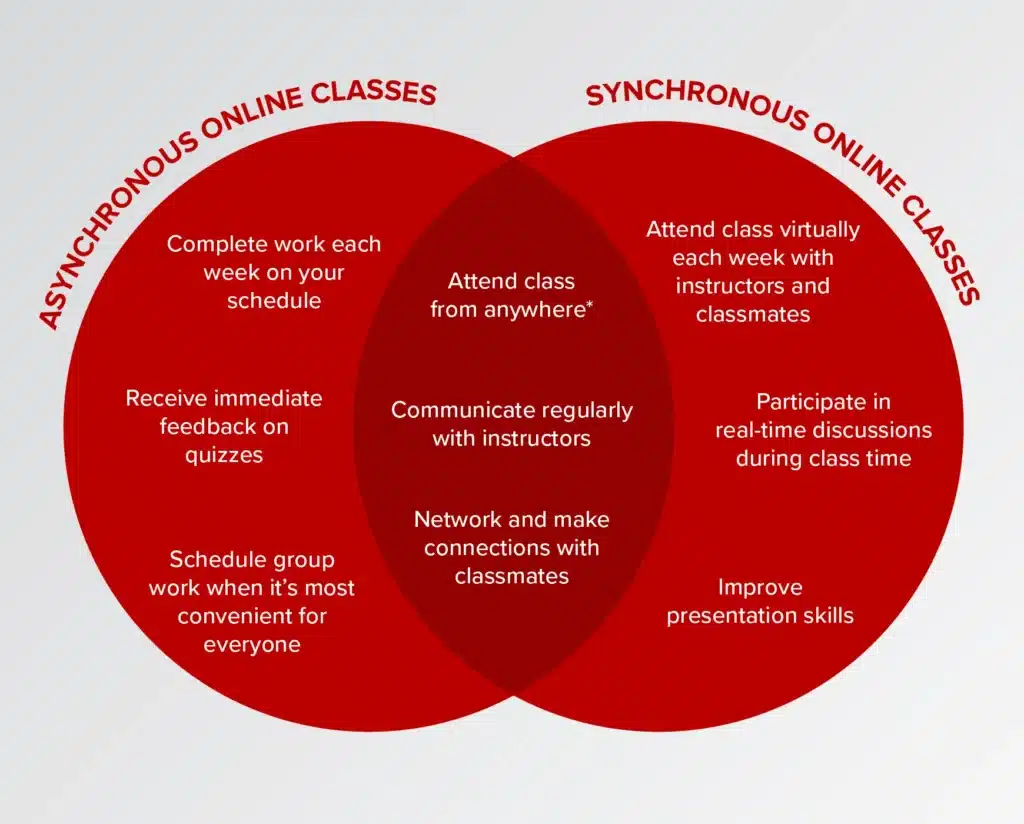
Venn diagram showing the differences and similarities of learning asynchronously and synchronously.
 
  • Asynchronous online classes: complete work each week on your schedule, receive immediate feedback on quizzes, schedule group work when it’s convenient for everyone.
  • Synchronous online classes: attend class virtually each week with instructors and classmates, participate in real-time discussions during class time, improve presentation skills.
  • Both: attend class from anywhere*, communicate regularly with instructors, network and make connections with classmates.

*The majority of our programs have no on-campus requirements. Please see your specific program’s page for state authorization information.

What is asynchronous learning?

Asynchronous learning allows you to learn on your own schedule, within a certain timeframe. You can access and complete lectures, readings, homework and other learning materials at any time during a one- or two-week period.

“A big benefit to asynchronous classes is, of course, the flexibility. Asynchronous online classes mean that you don’t always need to be online at the same time as your instructor or classmates,” said Instructional Designer John Muir, who works with faculty to develop classes for Ohio State’s online programs. “We know that students who are looking to take an entire program online are partially looking for that flexibility.”

Online asynchronous classes might include short videos teaching key concepts that you can watch over and over again, if necessary. In some classes, students can also complete homework assignments and receive immediate feedback, as opposed to waiting for instructors to grade them.

But don’t get the idea that asynchronous classes are any less rigorous than their synchronous or on-campus counterparts.

“Just like a student on campus, you should expect to be doing work one week at a time,” Muir said. “You should also expect to have contact with your instructor and classmates every week in a substantial way.”

For example, in HTHRHSC 4300: Contemporary Topics in Health and Society, a capstone course in the B.S. in Health Sciences program, students do most of their work according to their own schedules. However, they also sort themselves into groups based on schedule and availability, meeting weekly via video conferencing to collaborate on a research project that spans the semester.

Are you an educator hoping to advance your career? Explore our online education programs.

What is synchronous learning?

Synchronous learning means that although you will be learning from a distance, you will virtually attend a class session each week, at the same time as your instructor and classmates. The class is a firm, weekly time commitment that cannot be rescheduled. Much like an on-campus class, you will have readings and assignments to complete outside of class time to help prepare you to participate in the discussion. This kind of preparation from students, along with a dedicated agenda set by the instructor, ensures each class session is productive.

“A lot of careful planning and set up ahead of time makes those sessions into meaningful connections,” Muir said. “If the students can do it, and it’s thought through well by instructors, it can be a really powerful thing to add.”

Online synchronous learning doesn’t always just take the form of a live video lecture or an instructor-led discussion. Often, students will lead discussions themselves or give presentations to the rest of the class. In an online class, group work doesn’t go away, it just looks a little different. Muir explains that some instructors will pose case studies to students, who then have to negotiate an answer first as a small group and then together, as a class. Specific types of activities included in a synchronous course depend on the course and the program.

“There’s a lot of discipline-specific, really active things that go on in those sessions that aren’t just the equivalent of a recorded lecture,” Muir said. “It really is the same as doing some sort of activity in the classroom, just in a virtual setting.”

Ohio State’s Doctor of Nursing Practice program is one example of a program with synchronous online class requirements. One of the classes, NURSPRCT 8600: Organizational Culture, requires that students attend weekly evening class sessions using  CarmenZoom. Class discussion and interaction with the instructor occurs mainly during these meetings, with homework and readings available at any time in CarmenCanvas, Ohio State’s online learning management system.

How can I be successful in an online class?

No matter if your program is mostly asynchronous or synchronous, Muir reminds students to be deliberate with their time in order to be successful.

“In an online program, you really have to be respectful of yourself and plan your time and efforts,” he said. “It doesn’t matter if you’re in a synchronous or an asynchronous class, you need to know to block off your time to accomplish those things.”

Vivian Jones, M.Ed., academic advisor, says she often works with students who aren’t sure how synchronous or asynchronous classes will fit into their lives. To start with, knowing yourself and your own limitations is key to making decisions regarding your education.

“Remember that an online degree program itself is time-consuming,” Jones said. “Consider how you will manage a work-school-life balance. There is a lot of self-discipline involved.”

Jones said she also hears from students who fear they’ll feel disconnected or disengaged in an asynchronous, online course.

To combat feelings of isolation, Jones recommends students always reach out to their instructors and classmates and attempt to make meaningful connections.

“Respond to discussion posts and find people with similar interests to you or people doing things you don’t even know about, so you can maybe learn more about them,” she said. “Make relationships just as you would in a physical classroom.”

In an online class, student engagement needs to be more purposeful than an in-person class, where engagement may take place more naturally, but it’s crucial to ensure all students feel invested in their coursework.

“With online learning, student engagement is just different,” Jones said. “I see instructors in online classes really making an effort to make things personable and make people feel included. We’re trying to bring everyone together as one community, because online students are part of the Ohio State community.”

Interested in earning your Ohio State degree online? Learn more about our offerings.

How to Pay for Your Online Program

You’ve figured out which online program to pursue, applied by the deadline and now it’s time to figure out how to pay for it. Funding your education can feel daunting, but there are plenty of resources to help online students cover the bills.

“Online students apply for financial aid the same way they would for an on-campus program,” said Amy Wheeler, interim director of operations at Ohio State Student Financial Aid. “This includes completing the Free Application for Federal Student Aid (FAFSA) by the priority deadline.”

FAFSA

This form can be filled out annually by current and prospective college students (undergraduate and graduate) in the United States to determine eligibility for student financial aid. Your eligibility for federal grants and loans will generally be based on your financial need. You will supply this information on the FAFSA application.

Employer Contribution

Many employers offer educational contributions, but it can differ by organization. Check your company handbook and speak to your human resources contact to understand if funding is available for your online program. If you need tips on how to request funding, visit this article.

Grants

Along with federal grants from FAFSA, there are a slew of grants targeted to specific students, talents and categories. Grants typically do not need to be repaid, which makes them desirable and sometimes competitive.

Scholarships

Scholarships do not require repayment and are awarded for a variety of criteria. Read the guideline carefully before submitting an application to confirm you are eligible. Universities offer financial assistance in the form of merit as well.

For a list of scholarships available, please visit our ScholarshipUniverse website. The scholarship application will allow students to apply for different special-eligibility scholarships with a variety of eligibility criteria.

The Post-9/11 GI Bill®

The GI Bill® provides financial support for education and housing to individuals with at least 90 days of aggregate service on or after September 11, 2001, or individuals discharged with a service-connected disability after 30 days. You must have received an honorable discharge to be eligible. Additional resources for military and veteran students can be found at Ohio State Online.

Private Loans

When FAFSA loans and grants aren’t enough, a private loan can supplement the gaps in your finances. Be sure to check interest rates and speak to a student financial aid representative to get advice on borrowing responsibly.

Students Find Support from Professors and Peers in Online Programs

From social work to clinical research and beyond, students from across Ohio State’s online programs cite caring faculty mentors and strong peer networks with setting them up for success in their classes and their careers. We asked our online students to share how this support made a difference in their educational journeys and what it means to them to have a community to rely on – even from a distance.

Achieving success in spite of difficult circumstances

Tomitha Zimmerman, a graduate of the online Master of Social Work program, is from North Carolina. During her program, she encountered many personal hardships, including sustaining damage to her home during Hurricane Florence and losing her father.

“I was in a panic, stressed about family, safety and school. My biggest support and greatest strength came from my professors,” Zimmerman said. “During both situations Dr. Gerald Bean reached out to me to check on my well-being. He gave me ample time to catch up on work. I have never had such a personal experience from a professor, especially a distance professor.”

Zimmerman said that throughout this adversity, it was the kindness and flexibility from her professors and the program staff that encouraged her to keep going, even when her own resolve was faltering.

“I could not have faced so many obstacles without the support, strength and guidance from the faculty and staff. Even when times were tough, they believed in me, so I believed in me.”

Finding a network of like-minded peers and lifelong friends

For Larry Martin, a graduate of the online Master of Clinical Research program, the best of part of earning his degree online was finding a strong community of peers and developing friendships that continued even after graduation.

“A core group of us who took classes together still meet once a month for tea. I would have never come across most of these people if we didn’t do this program together,” Martin said.

According to Martin, the support system the group formed during their online program continued as they embarked on different career paths in the research field. Now, instead of discussing class projects, the group shares workplace challenges and growth opportunities.

“I see it as a work relationship, because we all discuss potential career opportunities that might exist for each other,” Martin said. “But, even more importantly, we encourage each other to keep going.”

Building industry connections and gaining hands-on experience

Cara North, a graduate of the online Master of Learning Technologies program, found it easy to build up industry connections and grow her network, something that jumpstarted her career after graduation. North cites the support she received from faculty with opening doors for her to network in her field.

“One of my instructors shared an opportunity to present at a conference,” North said. “I teamed up with a few classmates, and we presented together. It provided a chance for us to work together, network and build connections.”

North was able to extend her network through the online program and forge connections that have helped her both personally and professionally.

“Ohio State is a large institution with a lot of possibilities and opportunities,” said North. “You will meet people who you can connect with and who will connect you with others.”

Interested in earning your Ohio State degree online? Learn more about our offerings.

Are Online Degrees Respected?

Whether you are busy raising kids, swamped with a full-time job, or cannot justify the commute to campus, there are many reasons why an online degree could be the right option for you. As the world around us is constantly changing, growing, and adjusting, college degrees are no exception. Where an in-person college experience was the norm in the past, online degrees and e-learning are becoming increasingly popular. However, many students are asking the same questions: Are online degrees respected? Are online degrees respected by employers as much as an on-campus degree?

Even though online degrees are much more common in current times, you might still be apprehensive about a new method of learning. Some students worry that there will be a disconnect between their professors and fellow classmates. Here at Ohio State, an online degree is an Ohio State degree. Your degree will be the same as if you were an on-campus student. And to reflect that, you receive the same level of support and quality of education as your on-campus counterparts.

How Do I Choose the Best Online Degree for My Career?

One way to find the correct program for you is to consider the program’s learning mode. Would you prefer fully asynchronous learning, or would you prefer a more hands-on approach with more interaction, such as in a synchronous program? In addition, doing research and thinking about your own education goals are necessary to find a college fit for you.

You can easily find rankings of the best online degrees across the country to give you more guidance on quality programs. For instance, U.S. News & World Report ranked Ohio State among the top 10 in the nation for many of its online bachelor’s programs. However, quality and cost are not the only elements that you will be comparing between programs. You should also look at the accreditation of the school, as well as whether you will be able to balance your workload with other responsibilities. While choosing a degree that is right for you can be intimidating, there are tips and tricks to narrow down your search.

Do Employers Respect Online Degrees?

In this era of online learning, more students are considering virtual options. Ohio State had 5,160 students enrolled in online programs in 2021. With the rising number of online students comes a rising number of employees hired with online degrees. However, do employers respect online degrees?

Ben Hazen is no newcomer when it comes to the world of online education. Ben received one of his three master’s degrees fully online. He now teaches an online MBA course at Mississippi State University, is a visiting professor at the University of Dayton, and is also the Chief Integration Officer at PW Communications. In addition, Ben was a sponsor of one of the first capstone projects for the online Master of Translational Data Analytics program here at Ohio State.

“In reality, it really depends on the school and the type of degree,” Ben stated about the quality of online degrees. He also emphasized pairing your online degrees with other credentials or experiences, which will stand out to employers. Ben mentioned that he has never had any trouble finding a job with his online degree and that many times, hiring managers did not realize that his degree was obtained fully online.

How to List an Online Degree on a Resume

Creating a resume can be overwhelming, and you may not know how to list your online degree properly. However, Master of Learning Technologies student Elizabeth Trolli says it’s simple: Market your online degree just like an on-campus degree. Instead of focusing on the listing of an online degree on your resume, highlight the skills you have obtained from online learning during the interview process.

“The focus should be more on how you were able to integrate your concepts and learning into your position or leverage that into your career and possible career advancements,” Elizabeth stated. If you need help finding a starting point, Ohio State offers many resume guides.

Can You Get a Job with an Online Degree?

In short, yes! You can absolutely get a job using an online degree. Some aspects may heighten your chances of receiving your dream position, such as the accreditation of the college, student success rates, faculty credentials, as well as if they are affiliated with a brick-and-mortar campus, and more. Luckily, Ohio State excels at all these characteristics. As an accredited, non-profit, brick-and-mortar college with a large portfolio of online programs, Ohio State produces some of the most highly sought-after graduates, according to a survey by Times Higher Education. Overall, employers will be less concerned with how you earned your degree and more concerned with where. Depending on the school you attended, an online degree can absolutely be respected and accepted by employers. Earning an online degree shows time management skills, work ethic, and a desire to better yourself, which are all valuable strengths to take into the workplace.

What’s the Difference Between Asynchronous and Synchronous Learning?

As you research the right online program for you, you may come across the terms “asynchronous” and “synchronous.” You might not know what these words mean yet, but you’re probably already considering your work schedule and other responsibilities and how well each program would fit into your life. Are you able to log on and attend classes at specific times? Or is it more realistic for you to complete work each week at times that suit you best – no matter if it’s 3 p.m. or 3 a.m.? ​And, how do online classes even work?

Here’s what you should know: Asynchronous online learning allows students to view instructional materials each week at any time they choose and does not include a live video lecture component. On the other hand, synchronous online learning means that students are required to log in and participate in class at a specific time each week. The main difference between asynchronous learning and synchronous learning is this live instruction component occurring at a set time. We’ll describe more differences in the sections below, as well as some of the pros, cons, and best practices of each style.

We tapped Ohio State experts to explain the difference between asynchronous and synchronous learning and what each style actually means when it comes to online classes.

Venn diagram showing the differences and similarities of learning asynchronously and synchronously.
  • Asynchronous online classes: complete work each week on your schedule, receive immediate feedback on quizzes and schedule group work when it’s convenient for everyone.
  • Synchronous online classes: attend class virtually each week with instructors and classmates, participate in real-time discussions during class time and improve presentation skills.
  • Both: attend class from anywhere*, communicate regularly with instructors, network and make connections with classmates.

*The majority of our programs have no on-campus requirements. Please see your specific program’s page for state authorization information.

What is asynchronous learning?

Asynchronous learning allows you to learn on your own schedule, within a certain timeframe. You can access and complete lectures, readings, homework and other learning materials at any time during a one- or two-week period.

“A big benefit to asynchronous classes is, of course, the flexibility. Asynchronous online classes mean that you don’t always need to be online at the same time as your instructor or classmates,” said Instructional Designer John Muir, who works with faculty to develop classes for Ohio State’s online programs. “We know that students who are looking to take an entire program online are partially looking for that flexibility.”

Online asynchronous classes might include short videos teaching key concepts that you can watch over and over again, if necessary. In some classes, students can also complete homework assignments and receive immediate feedback, as opposed to waiting for instructors to grade them.

But don’t get the idea that asynchronous classes are any less rigorous than their synchronous or on-campus counterparts.

“Just like a student on campus, you should expect to be doing work one week at a time,” Muir said. “You should also expect to have contact with your instructor and classmates every week in a substantial way.”

For example, in HTHRHSC 4300: Contemporary Topics in Health and Society, a capstone course in the B.S. in Health Sciences program, students do most of their work according to their own schedules. However, they also sort themselves into groups based on schedule and availability, meeting weekly via video conferencing to collaborate on a research project that spans the semester.

What is synchronous learning?

Synchronous learning means that although you will be learning from a distance, you will virtually attend a class session each week, at the same time as your instructor and classmates. The class is a firm, weekly time commitment that cannot be rescheduled. Much like an on-campus class, you will have readings and assignments to complete outside of class time to help prepare you to participate in the discussion. This kind of preparation from students, along with a dedicated agenda set by the instructor, ensures each class session is productive.

“A lot of careful planning and set up ahead of time makes those sessions into meaningful connections,” Muir said. “If the students can do it, and it’s thought through well by instructors, it can be a really powerful thing to add.”

Online synchronous learning doesn’t always just take the form of a live video lecture or an instructor-led discussion. Often, students will lead discussions themselves or give presentations to the rest of the class. In an online class, group work doesn’t go away, it just looks a little different. Muir explains that some instructors will pose case studies to students, who then have to negotiate an answer first as a small group and then together, as a class. Specific types of activities included in a synchronous course depend on the course and the program.

“There’s a lot of discipline-specific, really active things that go on in those sessions that aren’t just the equivalent of a recorded lecture,” Muir said. “It really is the same as doing some sort of activity in the classroom, just in a virtual setting.”

Ohio State’s Doctor of Nursing Practice program is one example of a program with synchronous online class requirements. One of the classes, NURSPRCT 8600: Organizational Culture, requires that students attend weekly evening class sessions using CarmenZoom. Class discussion and interaction with the instructor occurs mainly during these meetings, with homework and readings available at any time in CarmenCanvas, Ohio State’s online learning management system.

How can I be successful in an online class?

No matter if your program is mostly asynchronous or synchronous, Muir reminds students to be deliberate with their time in order to be successful.

“In an online program, you really have to be respectful of yourself and plan your time and efforts,” he said. “It doesn’t matter if you’re in a synchronous or an asynchronous class, you need to know to block off your time to accomplish those things.”

Vivian Jones, M.Ed., academic advisor, says she often works with students who aren’t sure how synchronous or asynchronous classes will fit into their lives. First, knowing yourself and your limitations is key to making decisions regarding your education.

“Remember that an online degree program itself is time-consuming,” Jones said. “Consider how you will manage a work-school-life balance. There is a lot of self-discipline involved.”

Jones said she also hears from students who fear they’ll feel disconnected or disengaged in an asynchronous, online course.

To combat feelings of isolation, Jones recommends students always reach out to their instructors and classmates and attempt to make meaningful connections.

“Respond to discussion posts and find people with similar interests to you or people doing things you don’t even know about, so you can maybe learn more about them,” she said. “Make relationships just as you would in a physical classroom.”

In an online class, student engagement needs to be more purposeful than an in-person class, where engagement may take place more naturally, but it’s crucial to ensure all students feel invested in their coursework.

“With online learning, student engagement is just different,” Jones said. “I see instructors in online classes really making an effort to make things personable and make people feel included. We’re trying to bring everyone together as one community, because online students are part of the Ohio State community.”

Graduate’s Project on Homeless Housing Stability Wins Award

“In the words of Mahatma Gandhi, my career has embodied the hope of being the change I wish to see in the world,” said Joshua Raines, a recent graduate of the online Master of Social Work program.

He took inspiration from his work with National Church Residences, the largest non-profit provider of senior low-income housing in the United States, to do a capstone project on how a peer-support staff may impact housing stability for the homeless.

Raines was selected by his professor, Dr. Jerry Bean, to present his research project in a poster presentation event during the College of Social Work’s Annual Field Education Awards Breakfast. During that event, agency participants, guests, faculty and staff had an opportunity to engage with nominees about their research and vote on the most compelling one—Raines took the award home with his project.

His study looked at whether permanent supportive housing with certified peer specialists had an effect on housing stability. These specialists are individuals who have personal experience in recovery from mental health or substance abuse and are trained to support their peers in moving forward in their own recovery. He found this model had fewer emergency medical runs, in-patient hospitalizations, 10-day eviction notices and police visits than traditional models.

This impact was personally felt by one of Raines’ anonymous subjects, a formerly incarcerated individual who was homeless for over four years.

“I suffer from high anxiety and the peer specialists brought my stress level way down,” he said. “If I needed someone to talk to, they were here for me and gave me some good insight on things that actually help.”

Since receiving this award and graduating, Raines continues his mission to help others through the Permanent Supportive Housing division of National Church Residences.

“As social workers, we have the unique ability to walk alongside those we serve, providing them with access to services and supports that can enable them to live greater, more fulfilling lives. I can’t think of a higher privilege than to serve those who our society has set aside and I’ll continue to do so for decades to come.”

Learn how you can make a difference with the online Master of Social Work program.

How to be a sustainable online student

On campus, students are supported with recycling services, composting initiatives and a university-wide goal to produce zero waste by 2025. However, the Ohio State community has shifted to virtual instruction, prompting many students to become virtual learners in their own homes for the very first time.

Despite not being on campus, students can all still contribute to Ohio State’s sustainability initiatives at home. Now is the perfect time to assess our daily habits in our own homes and become more mindful towards our individual environmental impact. With practice and patience, you can be sure to emerge from social distancing with new eco-friendly habits.

Conserve energy.

For students learning at a distance, technology is your classroom. It may make sense to keep your tech gadgets plugged into the wall to charge at all times. They aren’t going anywhere, right?

Unfortunately, keeping devices constantly plugged into outlets wastes energy, even when the items are not being used. Conserve energy and save on your next electricity bill by unplugging your chargers from outlets when they are not in use.

Ohio State’s Green Home Technology Center has additional resources to offer when it comes to auditing your home energy efficiency in order to make practical changes.

Be your own cafeteria.

Spending an increased time at home has had an unintended side effect: everyone is learning to cook. Whether you are a master chef or have never used the oven, social distancing has encouraged increased creativity in the kitchen. Cooking for yourself can be an empowering hobby. When preparing your meals mindfully, home-cooked meals are oftentimes a bonus for the earth.

When preparing a large meal, store leftovers in the fridge or freezer to enjoy later. If you are not one for leftovers, try your best to prepare only what you or your family will eat in one sitting. By portioning recipes and properly storing leftovers, food waste can be minimized.

At Ohio State’s dining services, food waste is composted. Learn how to compost at home through Ohio State’s guide to indoor or outdoor composting. Ohio State researchers have also found that beginning to compost yourself creates a spillover effect for other positive behaviors such as conserving more water and energy.

The Ohio State University Wexner Medical Center has compiled healthy recipes that are easy to make at home. Take your sustainability up a notch by opting for a plant-based recipe, which places less stress on the environment compared to consuming animal livestock. Check out Ohio State’s Plant-Based for Beginners resource if you are interested in learning more about the lifestyle.

Replace mindfully.

As a virtual student, your home can become your campus. In light of the current pandemic, many students are faced with this very reality. As you spend more time at home, lights may burn out and appliances may need to be replaced. Before clicking the “order now” button, pause and see if you are opting for the most energy efficient option that is available to you.

Just as you would search for a used textbook, popular technology websites often have certified refurbished options available for purchase. If you find yourself needing to invest in a new tech accessory, try searching for a pre-owned option first.

By replacing mindfully and reusing items wherever possible, fewer resources are required and waste can be diverted from landfills leaving the earth (and your wallet) in a better place.

Explore your neighborhood.

When are you ever going to have the time to appreciate the outdoors this much again? Explore your neighborhood by taking a walk to appreciate the local landscape while adhering to all CDC guidelines for social distancing. You can even turn the outdoors into your RPAC by participating in a virtual 5K hosted by Ohio State on April 18th-19th.

One of the best ways to appreciate the earth is by getting to know it. Become involved in local efforts by supporting your neighborhood Community Supported Agriculture (CSA). CSAs are a partnership between local farms and the community. Comparable to a subscription service for fresh produce, households invest in the farmer’s crop-yield before the season begins in exchange for weekly in-season produce.

Get educated.

Now is the time to dive into new interests and read up on your lingering questions. Utilize the flexibility that comes with online coursework and schedule a time to research an environmental topic that you have always be curious about.

Here are some ideas to get you started:

  • Check out a TedxOhioStateUniversity talk by faculty member Bartow J. Elmore, an environmental historian. In just 15 minutes, Elmore, an associate professor of history and core faculty member of the Sustainability Institute at Ohio State, outlines the history of Coca-Cola and its impact on the environment.
  • Enroll in a self-paced class through Ohio State’s Open Learning initiative. Open Learning classes are free and open to everyone, not just Ohio State students. Consider selecting from a variety of courses including: Environmental Public Health, Biology and Management of Weeds and Invasive Plants, or Earth’s Environment: Soil, Water, and Air
  • Read an eBook through Ohio State’s expanded online library services offered in response to COVID-19.

Lead by example.

Learning new ways to lessen your environmental impact can be exciting. You might even find yourself wondering why everyone doesn’t adopt the habits you have discovered. However, it is especially important to approach environmental awareness humbly and without judgment.

Stacey Fineran, an assistant professor of professional practice who teaches environmental assessment in the School of Environment and Natural Resources and an affiliated faculty member of the Sustainability Institute at Ohio State, has a compassionate approach to learning about the environment.

“It is a personal journey,” Fineran says, regarding individual environmental responsibility. “You are caught up in a complex system, and there needs to be systemic changes allowing you to be empowered to make better choices.”

Large-scale systemic change is needed to create a sustainable future. However, by seeking answers and approaching environmental awareness with an open mind, we can all become active members of the conversation.

Find positive ways to be a part of environmentally conscious activities that bring you joy. Share your favorite vegan recipe or sell that used keyboard you haven’t touched in years.

With these tools in mind, being a virtual student can maximize your knowledge of your relationship with the earth.

“Have a humility that we don’t know everything yet, but we have this goal, passion and good reason for why we are trying to pursue this goal,” says Fineran. “That is what makes you a learner.”