What Can You Do With a Master’s Degree in Art Education?

The  online Master of Arts in Art Education  is designed for passionate educators who want to take their teaching and artmaking to the next level. The program is made up of a diverse cohort of artists with experience in the classroom, in the museum, on the stage, and in the community. If you are passionate about sharing your love of art with others and interested in a creative job, you might consider a graduate program in art education. But you may be wondering: What types of careers does this degree lead to? What can you do with a master’s in art education? Here are just a few examples of possible art education careers:

  • Art Teacher
  • Dance Instructor
  • Museum Educator

Primary and secondary school art teachers make up a portion of the nation’s art educators, and these educators can certainly benefit from a graduate degree. According to the U.S. Bureau of Labor Statistics, the median annual salary for elementary school teachers is $59,670, while secondary school teachers, including middle school and high school art teachers, can earn $61,660 a year.

However, according to the National Council on Teacher Quality (NCTQ), teachers with a master’s degree can earn an additional $2,760 a year on average in their first year of teaching compared to those with a bachelor’s degree – and this advantage increases with teaching experience. No matter what state you teach in, a master’s degree is a valuable credential, as the NCTQ reports that 88 percent of the largest school districts in the country offer an increase in pay to teachers with master’s degrees.

We spoke with current students in Ohio State’s online master’s program to learn what you can do with a master’s degree in art education and how the program impacted each of their careers – beyond just a salary increase.

Explore the stories below to learn more about real student experiences in the online art education master’s program, and reach out to us directly for more information on how this dynamic program can grow your career.

Elementary School Art Teacher

Brittany Schwarck has been an Elementary Art Teacher for six years and felt ready to further her education, using her real-world experiences as a lens with which to view her graduate course work. She says that a big benefit of the online format of the master’s in art education program is the ability to immediately  implement  and experiment with new ideas in her own classroom.

“I felt that through my own artmaking within this program, I walked away feeling empowered and inspired by my own work. I strive to help my students feel the same way,” Schwarck said.

Performing Artist and Studio Dance Instructor

Tatiana Piche is a Professional Ballet Dancer and Studio Dance Instructor. She found the art education master’s degree after searching for a program that would push her creatively, both as an artist and art educator.

“Over the years teaching in various schools and studios, I have fallen in love with the process of sharing my art and my passion for the performing arts – notably, because I have seen how the arts can empower, encourage, and give students a voice,” Piche said.

Museum Educator

Lynnette Torres is the Education Outreach Coordinator at the Booth Western Art Museum in Cartersville, Georgia. In her role, she helps museum guests connect with art on a personal level and facilitates artmaking with students as part of the museum’s programming. She often incorporates new concepts she learned in her graduate program at Ohio State into her day-to-day work in the museum.

“This program has allowed me to explore my own identity as an educator, a creator, a Latinx woman and an ally which has grown my desire to help others find their own connections with self through the exploration and making of art,” Torres said.

As you can see, earning your master’s in art education online can lead to diverse career opportunities. Although becoming an art teacher may be the first thing that comes to mind when you hear “art education,” this flexible online degree can be customized to prepare you for whatever creative career you choose.

What can you do with a bioethics master’s degree?

The Master of Arts in Bioethics at Ohio State is an interdisciplinary and fully online master’s degree designed for healthcare professionals, researchers, legal professionals, social scientists, or anyone with an interest in engaging with questions in bioethics, whether they be biomedical, social, technological, ecological, religious, or philosophical. Students who pursue a bioethics degree will find a wide range of areas of inquiry and applications.

In what fields do graduates of the online bioethics master’s program work? Because bioethics is interdisciplinary and multidisciplinary, our graduates go on to work in a variety of professions and fields, including:

  • Medicine
  • Veterinary medicine
  • Social work
  • Health law
  • Policymaking
  • Public health
  • Biomedical research
  • Chaplaincy
  • Dentistry

What can you do with an online bioethics master’s degree?

Because bioethics is an interdisciplinary and multidisciplinary field, you can use a bioethics degree in many career paths. While some choose to pursue a primary career in ethics most of our students pursue an education in bioethics to enhance another professional field. Individuals who choose bioethics as a primary career often work as clinical ethicists within a healthcare institution or system. Others use their bioethics degree to complement their primary career-for example, in law or health care-by providing specialized expertise and skills. Many of our graduates also use their bioethics degree to gain leadership positions within their organizations, including serving as chairs of ethics committees or directors of mission and ethics. As you can see, the career outcomes for the program are as diverse and varied as the program itself.
Discover a few job titles held by graduates of the online Master of Arts in Bioethics:

  • Neonatologist
  • Clinical Research Ethicist
  • Assistant Professor and Palliative Care Physician

We spoke with a few of our graduates to learn more about their educational journeys and how the online bioethics master’s degree has helped them grow their unique careers. Explore their stories below, or reach out to us directly, to learn what you can do with a bioethics master’s degree from Ohio State.

Neonatologist

A neonatology fellowship at Nationwide Children’s Hospital inspired Dr. Hevil Shah to explore the bioethics master’s program at Ohio State. With improvements in technology pushing the limits of viability for future generations, Dr. Shah started thinking about the ethical implications of such medical decisions and what they would ultimately mean for families.

“When I started wanting that background knowledge, that’s what got me interested in the program – because this is the future,” Dr. Shah said. “Every NICU and neonatal practice is going toward offering the possibility of life and hope to children where even a few years ago that wasn’t possible. And there’s a lot of outcomes where we’re going to have to figure out what this all means from a biomedical ethics standpoint.”

Dr. Shah valued the opportunity his courses provided to have conversations with peers located around the country from a variety of backgrounds and professions and hear their experiences firsthand – while sharing his own.

“In my classes, I might be talking to someone who has never been inside a NICU, who has no idea what it means to have a child with cerebral palsy or developmental difficulties. It can really change your perspective to hear about those things from a person who has seen or experienced them rather than just read about them,” Dr. Shah said.

Now a neonatologist in Fort Worth, Texas, Dr. Shah credits Ohio State’s bioethics master’s program with opening his mind and providing the tools to have difficult conversations.

“The Master of Bioethics program made me a better physician. When you hear about that ’22-week miracle baby,’ you don’t consider what ethical questions were running through the minds of the doctors, the nursing staff or the families. There’s so much we don’t see when we’re hearing that story on social media,” Dr. Shah said. “Now that I have the training, I can have those difficult conversations with my staff and the families when the outcome is different and try to provide closure.”

“The Master of Bioethics program made me a better physician…Now that I have the training, I can have those difficult conversations with my staff and the families and try to provide closure.”
-Dr. Hevil Shah

Clinical Research Ethicist

Alumna Alana Monzon is a clinical research ethicist, specializing in human subject protections for the National Institute of Health’s Division of AIDS research. Each day, she reviews informed consent documents, ensures adherence to federal and international regulations, and translates the ethical basis of those regulations to researchers. Monzon enrolled in the Master of Arts in Bioethics program hoping to advance her career in health research, and along the way, discovered a passion for health research equity.

“The online bioethics master’s program provided knowledge in the background of my profession and an understanding of why my job exists in the first place – as a measure to protect participants in research from harm, coercion, and unethical treatment,” Monzon said. “From climate change to humanitarian crises to social injustice, bioethics serves a vital role as we think about how life can flourish. Studying in this program will give you new ways of thinking about old problems and help you to always approach new challenges with a critical and open mind.”

“From climate change to humanitarian crises to social injustice, bioethics serves a vital role as we think about how life can flourish. Studying in this program will give you new ways of thinking about old problems and help you to always approach new challenges with a critical and open mind.”
-Alana Monzon

Assistant Professor and Palliative Care Physician

Bioethics graduate-turned-professor Dr. Nicole Shirilla first became interested in bioethics through her work as palliative care physician. Caring for extremely ill patients, often toward the end of their lives, brought up many ethical considerations, and she wanted training to ensure she was serving both her patients and her colleagues well. Ohio State’s online bioethics master’s program was the perfect fit. With the help of her advisors, Dr. Shirilla was able to map out a plan of study that allowed her to graduate in two years, while working full time.

A fellowship in clinical ethics helped Dr. Shirilla obtain the hands-on experience she was looking for, but the bioethics master’s program provided the formal education she needed to achieve her goal of becoming an educator.

“As someone who wants to teach and lead others, completing this degree was really important to me,” she said. “Since completing the degree, I have been given more opportunities to teach at the medical school. I am now starting to have a teaching role within the master’s program, as well, co-teaching classes that I took when I was a student: Clinical Ethics and End-of-Life Ethics.”

With the continuation of the COVID-19 pandemic, Dr. Shirilla’s work as a clinical ethicist and medical educator has become even more challenging – and rewarding.

“As graduates of this program, we’ve been trained to engage in biomedical ethics conversations, recognizing that it’s almost certain that people in a diverse, pluralistic society will have differing perspectives,” Dr. Shirilla said.

“Being able to dialogue in a respectful and professional way is incredibly important – all while striving toward the best ethic possible in any given situation. That’s the tension and the excitement and the value of the role of clinical ethics. Undoubtedly, it can be incredibly challenging at times. But if we don’t do it, who would? And what would be the consequence if people weren’t willing to engage on matters that can be challenging?”

“The work can be incredibly challenging at times. But if we don’t do it, who would? And what would be the consequence if people weren’t willing to engage on matters that can be challenging?”
-Dr. Nicole Shirilla

Ohio State’s online Master of Arts in Bioethics is applicable to a wide range of professions, allowing students the opportunity to explore and discover answers to the ethical questions they’re most passionate about.

Want to learn more about this interdisciplinary online master’s degree? Contact us or visit our website for more information, and we can help you on your journey.

What Can I Do with an Educational Technology Master’s Degree?

As technology is continually advancing and expanding access for students worldwide, it is critical for educators to stay up to date with the latest teaching tools and methods. The online Master of Learning Technologies (MLT) at Ohio State teaches educators how to conduct and apply research to better support learning with technology. An educational technology master’s degree can give you the tools to adapt to new situations, gain critical thinking skills, and resolve issues on your own. In addition, there are multiple career paths open to educators with this degree, such as:

  • Instructional Designer
  • Educational Technologist
  • Technology Integration Specialist

We spoke with a current student to learn more about her educational journey and how the online educational technology master’s degree has helped her grow her career. To learn more, reach out to us directly.

Allison Schultz, a current online Master of Learning Technologies student, is using her degree to build her competencies in instructional design and explore the ways individuals learn. Allison is currently an instructional design library liaison in the Office of Technology and Digital Innovation.

“I want to combine evidence-based instruction with my library background to help instructors develop information literacy skills in their students,” Schultz explained when asked what her goals were after graduation. Focusing on literacy is just one of the many uses of an educational technology master’s degree.

Allison also described how her time in the MLT program has given her a range of real-life skills that she has already gotten to use in her career. “I think the program’s emphasis on authentic, real-world application of learning technologies, will help me see connections between my work and educational experiences,” Schultz said.

“I think the program’s emphasis on authentic, real-world application of learning technologies, will help me see connections between my work and educational experiences.”
– Allison Schultz

Instructional Designer

One of the most common lines of work using an educational technology master’s degree is instructional design. So, what does an instructional designer do? These individuals are tasked with overseeing curriculums and teaching standards, often within higher education. They may be responsible for developing or redesigning courses, as well as other learning materials. According to the Bureau of Labor Statistics, instructional coordinator openings are expected to grow by 10% from 2020 to 2030. The BLS also said that the median pay for instructional coordinators in 2021 was $63,740.

Educational Technologist

Another option for students graduating with an educational technology master’s degree is to become an educational technologist. While instructional designers and educational technologists play similar roles, they can also have differences in their work. The main responsibilities of instructional designers are to design, manage, train, and provide support related to course development. In contrast, educational technologists focus on identifying, purchasing, and supporting technology and computer networks, as well as training instructors to use the technology.

Technology Integration Specialist

In addition, an educational technology master’s degree from Ohio State could land you a position as a technology integration specialist. In this role, individuals will often collaborate with educators to support, manage and optimize the use of software and network resources. Technology integration specialists work within the IT (Information Technology) team and must be able to work in a group as well as individually.

Obtaining an educational technology master’s degree can set you up to work in a variety of different fields and roles. If you’re interested in a career in educational technology, it is important to choose the right program. Ohio State’s online graduate education programs were ranked No. 28 in the country by U.S. News & World Report for our online Educational and Instructional Media Design specialty.

Want to learn more about this educational technology master’s degree? Contact us or visit our website for more information and we can help you on your journey.
Are Online Degrees Respected?

Whether you are busy raising kids, swamped with a full-time job, or cannot justify the commute to campus, there are many reasons why an online degree could be the right option for you. As the world around us is constantly changing, growing, and adjusting, college degrees are no exception. Where an in-person college experience was the norm in the past, online degrees and e-learning are becoming increasingly popular. However, many students are asking the same questions: Are online degrees respected? Are online degrees respected by employers as much as an on-campus degree?

Even though online degrees are much more common in current times, you might still be apprehensive about a new method of learning. Some students worry that there will be a disconnect between their professors and fellow classmates. Here at Ohio State, an online degree is an Ohio State degree. Your degree will be the same as if you were an on-campus student. And to reflect that, you receive the same level of support and quality of education as your on-campus counterparts.

How Do I Choose the Best Online Degree for My Career?

One way to find the correct program for you is to consider the program’s learning mode. Would you prefer fully asynchronous learning, or would you prefer a more hands-on approach with more interaction, such as in a synchronous program? In addition, doing research and thinking about your own education goals are necessary to find a college fit for you.

You can easily find rankings of the best online degrees across the country to give you more guidance on quality programs. For instance, U.S. News & World Report ranked Ohio State among the top 10 in the nation for many of its online bachelor’s programs. However, quality and cost are not the only elements that you will be comparing between programs. You should also look at the accreditation of the school, as well as whether you will be able to balance your workload with other responsibilities. While choosing a degree that is right for you can be intimidating, there are tips and tricks to narrow down your search.

Do Employers Respect Online Degrees?

In this era of online learning, more students are considering virtual options. Ohio State had 5,160 students enrolled in online programs in 2021. With the rising number of online students comes a rising number of employees hired with online degrees. However, do employers respect online degrees?

Ben Hazen is no newcomer when it comes to the world of online education. Ben received one of his three master’s degrees fully online. He now teaches an online MBA course at Mississippi State University, is a visiting professor at the University of Dayton, and is also the Chief Integration Officer at PW Communications. In addition, Ben was a sponsor of one of the first capstone projects for the online Master of Translational Data Analytics program here at Ohio State.

“In reality, it really depends on the school and the type of degree,” Ben stated about the quality of online degrees. He also emphasized pairing your online degrees with other credentials or experiences, which will stand out to employers. Ben mentioned that he has never had any trouble finding a job with his online degree and that many times, hiring managers did not realize that his degree was obtained fully online.

How to List an Online Degree on a Resume

Creating a resume can be overwhelming, and you may not know how to list your online degree properly. However, Master of Learning Technologies student Elizabeth Trolli says it’s simple: Market your online degree just like an on-campus degree. Instead of focusing on the listing of an online degree on your resume, highlight the skills you have obtained from online learning during the interview process.

“The focus should be more on how you were able to integrate your concepts and learning into your position or leverage that into your career and possible career advancements,” Elizabeth stated. If you need help finding a starting point, Ohio State offers many resume guides.

Can You Get a Job with an Online Degree?

In short, yes! You can absolutely get a job using an online degree. Some aspects may heighten your chances of receiving your dream position, such as the accreditation of the college, student success rates, faculty credentials, as well as if they are affiliated with a brick-and-mortar campus, and more. Luckily, Ohio State excels at all these characteristics. As an accredited, non-profit, brick-and-mortar college with a large portfolio of online programs, Ohio State produces some of the most highly sought-after graduates, according to a survey by Times Higher Education. Overall, employers will be less concerned with how you earned your degree and more concerned with where. Depending on the school you attended, an online degree can absolutely be respected and accepted by employers. Earning an online degree shows time management skills, work ethic, and a desire to better yourself, which are all valuable strengths to take into the workplace.

What’s the Difference Between Asynchronous and Synchronous Learning?

As you research the right online program for you, you may come across the terms “asynchronous” and “synchronous.” You might not know what these words mean yet, but you’re probably already considering your work schedule and other responsibilities and how well each program would fit into your life. Are you able to log on and attend classes at specific times? Or is it more realistic for you to complete work each week at times that suit you best – no matter if it’s 3 p.m. or 3 a.m.? ​And, how do online classes even work?

Here’s what you should know: Asynchronous online learning allows students to view instructional materials each week at any time they choose and does not include a live video lecture component. On the other hand, synchronous online learning means that students are required to log in and participate in class at a specific time each week. The main difference between asynchronous learning and synchronous learning is this live instruction component occurring at a set time. We’ll describe more differences in the sections below, as well as some of the pros, cons, and best practices of each style.

We tapped Ohio State experts to explain the difference between asynchronous and synchronous learning and what each style actually means when it comes to online classes.

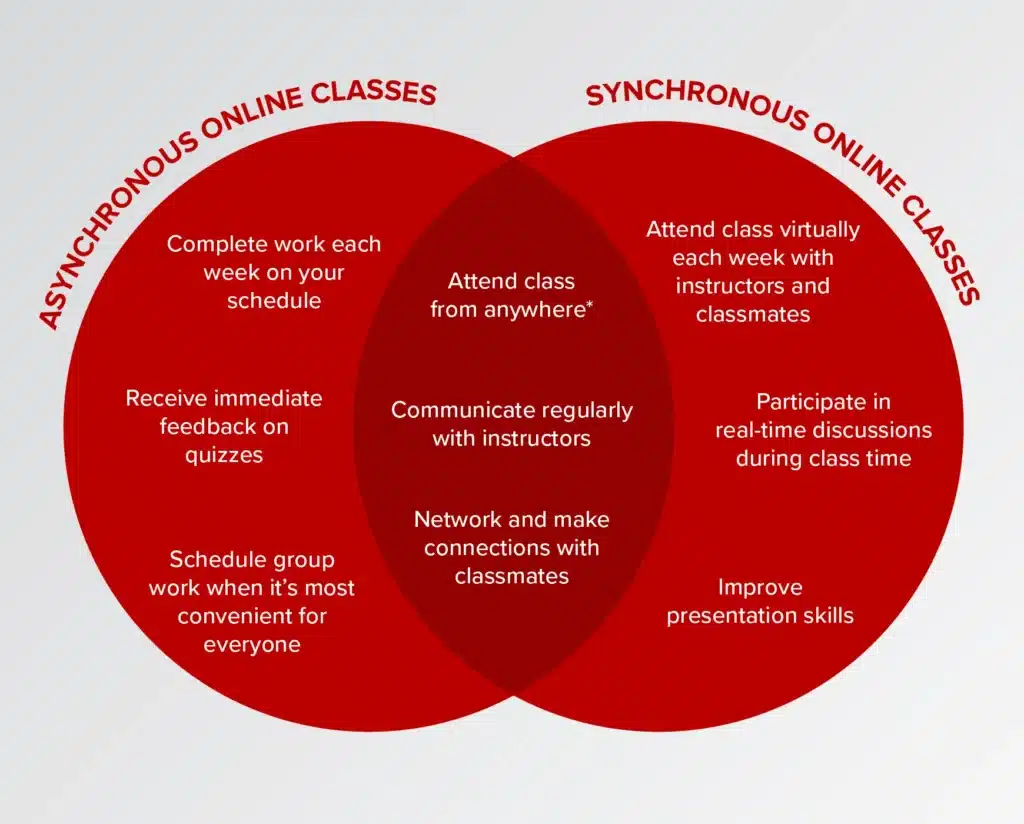
Venn diagram showing the differences and similarities of learning asynchronously and synchronously.
  • Asynchronous online classes: complete work each week on your schedule, receive immediate feedback on quizzes and schedule group work when it’s convenient for everyone.
  • Synchronous online classes: attend class virtually each week with instructors and classmates, participate in real-time discussions during class time and improve presentation skills.
  • Both: attend class from anywhere*, communicate regularly with instructors, network and make connections with classmates.

*The majority of our programs have no on-campus requirements. Please see your specific program’s page for state authorization information.

What is asynchronous learning?

Asynchronous learning allows you to learn on your own schedule, within a certain timeframe. You can access and complete lectures, readings, homework and other learning materials at any time during a one- or two-week period.

“A big benefit to asynchronous classes is, of course, the flexibility. Asynchronous online classes mean that you don’t always need to be online at the same time as your instructor or classmates,” said Instructional Designer John Muir, who works with faculty to develop classes for Ohio State’s online programs. “We know that students who are looking to take an entire program online are partially looking for that flexibility.”

Online asynchronous classes might include short videos teaching key concepts that you can watch over and over again, if necessary. In some classes, students can also complete homework assignments and receive immediate feedback, as opposed to waiting for instructors to grade them.

But don’t get the idea that asynchronous classes are any less rigorous than their synchronous or on-campus counterparts.

“Just like a student on campus, you should expect to be doing work one week at a time,” Muir said. “You should also expect to have contact with your instructor and classmates every week in a substantial way.”

For example, in HTHRHSC 4300: Contemporary Topics in Health and Society, a capstone course in the B.S. in Health Sciences program, students do most of their work according to their own schedules. However, they also sort themselves into groups based on schedule and availability, meeting weekly via video conferencing to collaborate on a research project that spans the semester.

What is synchronous learning?

Synchronous learning means that although you will be learning from a distance, you will virtually attend a class session each week, at the same time as your instructor and classmates. The class is a firm, weekly time commitment that cannot be rescheduled. Much like an on-campus class, you will have readings and assignments to complete outside of class time to help prepare you to participate in the discussion. This kind of preparation from students, along with a dedicated agenda set by the instructor, ensures each class session is productive.

“A lot of careful planning and set up ahead of time makes those sessions into meaningful connections,” Muir said. “If the students can do it, and it’s thought through well by instructors, it can be a really powerful thing to add.”

Online synchronous learning doesn’t always just take the form of a live video lecture or an instructor-led discussion. Often, students will lead discussions themselves or give presentations to the rest of the class. In an online class, group work doesn’t go away, it just looks a little different. Muir explains that some instructors will pose case studies to students, who then have to negotiate an answer first as a small group and then together, as a class. Specific types of activities included in a synchronous course depend on the course and the program.

“There’s a lot of discipline-specific, really active things that go on in those sessions that aren’t just the equivalent of a recorded lecture,” Muir said. “It really is the same as doing some sort of activity in the classroom, just in a virtual setting.”

Ohio State’s Doctor of Nursing Practice program is one example of a program with synchronous online class requirements. One of the classes, NURSPRCT 8600: Organizational Culture, requires that students attend weekly evening class sessions using CarmenZoom. Class discussion and interaction with the instructor occurs mainly during these meetings, with homework and readings available at any time in CarmenCanvas, Ohio State’s online learning management system.

How can I be successful in an online class?

No matter if your program is mostly asynchronous or synchronous, Muir reminds students to be deliberate with their time in order to be successful.

“In an online program, you really have to be respectful of yourself and plan your time and efforts,” he said. “It doesn’t matter if you’re in a synchronous or an asynchronous class, you need to know to block off your time to accomplish those things.”

Vivian Jones, M.Ed., academic advisor, says she often works with students who aren’t sure how synchronous or asynchronous classes will fit into their lives. First, knowing yourself and your limitations is key to making decisions regarding your education.

“Remember that an online degree program itself is time-consuming,” Jones said. “Consider how you will manage a work-school-life balance. There is a lot of self-discipline involved.”

Jones said she also hears from students who fear they’ll feel disconnected or disengaged in an asynchronous, online course.

To combat feelings of isolation, Jones recommends students always reach out to their instructors and classmates and attempt to make meaningful connections.

“Respond to discussion posts and find people with similar interests to you or people doing things you don’t even know about, so you can maybe learn more about them,” she said. “Make relationships just as you would in a physical classroom.”

In an online class, student engagement needs to be more purposeful than an in-person class, where engagement may take place more naturally, but it’s crucial to ensure all students feel invested in their coursework.

“With online learning, student engagement is just different,” Jones said. “I see instructors in online classes really making an effort to make things personable and make people feel included. We’re trying to bring everyone together as one community, because online students are part of the Ohio State community.”

Graduate’s Project on Homeless Housing Stability Wins Award

“In the words of Mahatma Gandhi, my career has embodied the hope of being the change I wish to see in the world,” said Joshua Raines, a recent graduate of the online Master of Social Work program.

He took inspiration from his work with National Church Residences, the largest non-profit provider of senior low-income housing in the United States, to do a capstone project on how a peer-support staff may impact housing stability for the homeless.

Raines was selected by his professor, Dr. Jerry Bean, to present his research project in a poster presentation event during the College of Social Work’s Annual Field Education Awards Breakfast. During that event, agency participants, guests, faculty and staff had an opportunity to engage with nominees about their research and vote on the most compelling one—Raines took the award home with his project.

His study looked at whether permanent supportive housing with certified peer specialists had an effect on housing stability. These specialists are individuals who have personal experience in recovery from mental health or substance abuse and are trained to support their peers in moving forward in their own recovery. He found this model had fewer emergency medical runs, in-patient hospitalizations, 10-day eviction notices and police visits than traditional models.

This impact was personally felt by one of Raines’ anonymous subjects, a formerly incarcerated individual who was homeless for over four years.

“I suffer from high anxiety and the peer specialists brought my stress level way down,” he said. “If I needed someone to talk to, they were here for me and gave me some good insight on things that actually help.”

Since receiving this award and graduating, Raines continues his mission to help others through the Permanent Supportive Housing division of National Church Residences.

“As social workers, we have the unique ability to walk alongside those we serve, providing them with access to services and supports that can enable them to live greater, more fulfilling lives. I can’t think of a higher privilege than to serve those who our society has set aside and I’ll continue to do so for decades to come.”

Learn how you can make a difference with the online Master of Social Work program.

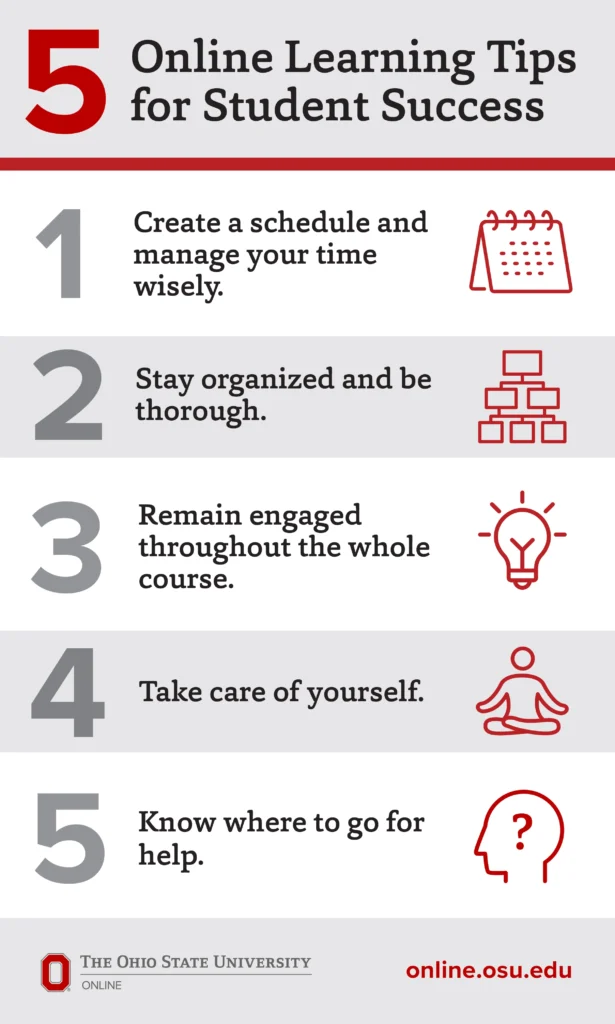
5 Online Learning Tips for Student Success

Whether you’re new to online classes or you’re an expert distance learner, everyone can benefit from these tips for online learning success. Time management, organization and motivation will take you far while you earn your degree online – as will knowing where to go when you need help.

Our dedicated faculty and staff understand the unique challenges of learning online, so don’t be afraid to reach out for guidance in your journey, so we can help you prepare for success.

Taking some time and answering the questions below can help you learn to be successful in your online program. Remember: Learning methods can vary from student to student. It’s all about finding which of these helpful tips for online learning work best for you.

A scarlet and gray infographic shares 5 tips for online learning and methods to achieve success as an online student.

  1. Create a schedule and manage your time wisely.

  • Keep a semester and a weekly calendar. On the first day of class, read the course syllabus and enter all due dates in your calendar, along with reminders for the due dates.
  • Commit to studying or participating in your online class for at least three hours per week for every one credit hour the course is worth. According to experienced online learners, one of the most helpful tips for online learning is to be deliberate with your time.
  • Learn the difference between asynchronous and synchronous online courses, and develop strategies for success in each format.
  • Prioritize your work. What due dates are coming up first? What information is the most important for you to learn? What assignments are worth the most points? Make a smart decision about how to best spend your time.

​

  1. Stay organized and be thorough.

  • Have a designated study space that is free of distractions so you can focus on your work.
  • Here’s one of our best tips for online learning: Prepare as if you have to teach the information you are studying. Organize information by creating charts, outlines, study guides, flashcards, concept maps and chapter maps. Create practice exams to evaluate your mastery of the material.
  • Use smart test-taking strategies. Before a quiz or exam, write down formulas or other information you may need. Survey the exam before starting and budget your time. Begin with the easiest test questions and work your way to the harder ones. Expect memory blocks. Often the information will come back to you if you move on to other questions.

​

  1. Remain engaged throughout the whole course.

  • Prepare and review for every lesson, attend in person/virtual class sessions and take active notes.
  • Analyze all returned quizzes and tests as well as any instructor feedback and develop a plan for improvement.
  • Make use of office hours on a regular basis and ask questions of instructors or peers if needed. Your fellow online students are a great resource to discover even more tips for online learning success.

​

  1. Take care of yourself.

  • Look inward for your motivation. Remembering the goal you are working toward will help you as you work through the challenges of being a student.
  • Stay healthy by getting adequate rest, nutrition and exercise. Use positive self-talk to reduce anxiety. Schedule time to take care of yourself and spend time with your friends and family.
  • Keep a growth mindset. Your success has as much to do with your effort as it has to do with your ability. Monitor your self-talk and stay positive.

​

  1. Know where to turn for help.

Graduate Certificate vs. Master’s Degree

 At some point in your professional career, you’ll undoubtedly explore the possibility of earning credentials beyond a bachelor’s degree. While there are many different types of credentials that indicate achievement in a skill or subject matter, two of the most common are graduate certificates and master’s degrees. By earning a graduate certificate or master’s degree, you’ll learn skills that you can immediately apply to your professional life. Most higher education institutions offer both types of programs, and many offer them online or in person.

When it comes to deciding whether a master’s degree or graduate certificate is right for you, there are many factors to take into account. It’s important to know which option will be most beneficial in the next steps of your career. Ohio State Online’s experts can help guide you through this process, so send us any questions you may have.

No matter what you decide, the most important thing is the ability to apply these credentials and skills to your professional life. Before you decide which type of program you should choose, it is helpful to understand the benefits of each.

What is a graduate certificate? Is a graduate certificate a degree?

A graduate certificate is a credential representing specialized training in a specific topic or skill. Sometimes referred to as a “professional certificate,” graduate certificates offer professional development training ideal for fine-tuning skills or knowledge within a defined framework of study, complementing your experience or growing your expertise in a specific subject. Graduate certificates can also provide opportunities for career advancement in a particular field or industry, or prepare students to sit for certain licensure exams.

These programs typically only take a short period of time, often between 12-15 credit hours (or one to two semesters, if attending full time). Due to their relatively short time to completion, a graduate certificate typically costs less than a master’s degree.

Is a graduate certificate a degree?

A graduate certificate is not considered a graduate degree, like a master’s or doctoral degree. However, it can provide a strong foundation for future study that results in a graduate degree. The credits earned in a graduate certificate program may satisfy requirements for entry into certain graduate programs.

Graduate certificates may also provide the skills necessary to transition to a new field of work.

Why earn a master’s degree?

Compared to graduate certificates, a master’s degree focuses on strategic skill development in a field rather than specialization on a single subject. Within a master’s degree program, there is typically more freedom to customize your experience to your interest and goals. Many advanced positions, especially in public administration or business, require a master’s degree as a prerequisite, and a master’s degree is necessary if you have the desire to eventually earn a doctorate degree.

Like graduate certificates, some master’s degrees allow students the opportunity to earn industry-recognized credentials – which may be required if you’re changing careers. For example, graduating from the online Master of Clinical Research program qualifies students to earn their Clinical Research Coordinator Certification, Clinical Research Professionals Certification or Regulatory Affairs Certification, after a requisite time period working in the field.

Based on data provided by the U.S. Bureau of Labor Statistics, master’s degree holders earn more than 16% higher wages than bachelor’s degree holders. A master’s degree typically takes one to two years to complete if attending full time, and thus typically costs more than a graduate certificate.

How to decide between a graduate certificate and a master’s degree

Your choice of whether to earn a master’s degree or graduate certificate will depend on your personal and professional goals. To decide which type of credential is right for you, consider the following factors:

What are your career goals?

Graduate certificates and master’s degrees can each lead to career advancement, whether you’re looking for a new job or a promotion in your current role. While graduate certificates may be valuable within a particular field, master’s degree credentials are typically more easily transferable between industries.

What new skills do you hope to gain?

Developing new skills or fine-tuning your abilities are vital for professional development. A master’s degree and a graduate certificate will each teach you new skills to apply to your professional life. A master’s degree will not only help you develop skills, but also provide you with the strategic vision to apply those skills in a variety of environments. A graduate certificate will focus specifically on one skill or a limited set of skills.

How much time and money can you invest in a program?

A graduate certificate typically takes less than one year to complete, while a master’s degree will typically take one to two years, perhaps longer if you enroll part-time. To continue working full time as you earn your credential, consider enrolling in an online graduate certificate or online master’s degree program that allows you to complete work on your own schedule.

A graduate certificate can typically be earned for a fraction of the cost of a master’s degree, though each should be seen as an investment in your future.

Earning both a graduate certificate and a master’s degree

In some instances, it may be helpful to earn both a graduate certificate and a master’s degree. Some master’s degree programs, like the online Master of Public Administration and Leadership from the John Glenn College of Public Affairs, allow credits from a graduate certificate to be applied to a master’s degree so that you may continue your education.

Similarly, the online Assistive and Rehabilitative Technology Graduate Certificate can complement advanced study in health and rehabilitation sciences, and selected credits may apply toward the online Master of Science in Health and Rehabilitation Sciences, allowing students to build expertise while progressing toward a graduate degree.

Finding a graduate certificate or master’s degree program

As you evaluate whether you want to earn a graduate certificate or master’s degree, weigh the pros and cons of both options. Each can be a valuable investment, regardless of your level of experience in your field, whether you recently graduated, are looking to change your field, or simply looking for a new challenge.

How do online classes work?

As you prepare for the next step in your educational journey, you are probably wondering what an online classroom looks like and how online classes work. It’s completely natural to have questions – and even concerns – about online learning, especially if your previous educational experiences have been in a traditional in-person class setting. In this article, we’ll explore how online classes actually work and what online classes look like at Ohio State. Still have questions? Reach out for more information about earning your degree online at Ohio State.

What are online classes like?

You may have heard that online classes can be disorganized or isolating for students. But that’s not the case at Ohio State! Our instructors design their online classes to use technology as a benefit, not a hurdle to overcome. Ohio State professors also work with our expert online course designers, known as instructional designers, who can help them transform their course material for an online format. 

Most Ohio State online classes are offered in an asynchronous format. In an asynchronous course, work is completed on your own time within a certain timeframe. Some online programs are offered in a synchronous format. In a synchronous course, students will virtually attend a class session each week at the same time as their instructors and classmates.

What is the Canvas learning management system?

For online students at Ohio State, CarmenCanvas is the room where it happens. Carmen is a learning management system where students can virtually attend lectures, complete readings, submit homework or quizzes and interact with their professors and classmates. If you have additional question, talk to one of our Enrollment Advisors or check out more of our blogs where you can find more tips and strategies for learning online.

The Do’s and Don’ts of Online Classes

The time has come! You’re getting ready to begin your first online class at Ohio State. But before jumping into online learning, it’s important to understand the basic do’s and don’ts in online classes.

If you’re new to learning online, it’s understandable that you’d have a few questions. Maybe you’re not sure how participation will work, or if attendance is mandatory in an online class. You might be confused about terminology such as “asynchronous learning” versus “synchronous learning.” Or maybe you haven’t been a student in a while and need a reminder on the best ways to study and be productive.

No matter what questions you may have, we’ve got you covered. Read on for our list of do’s and don’ts for success in your online classes, and reach out to us with any questions not answered here.

Getting Started

DO: Prepare for your course to begin.

Just like an on-the-ground course, you will be expected to participate and be involved in the assignments of your online class. Before the semester begins, make sure you have the technology you need, read the course syllabus and reach out to your professor with any questions.

DON’T: Expect to be anonymous in your online course.

A key piece of any online course is communication. Your instructor and fellow students expect you to be engaged and interact in the class – either during live sessions on CarmenZoom or in asynchronous discussions on CarmenCanvas. Your instructor may take attendance if you are enrolled in a class with a synchronous lecture component.

DO: Prepare to commit time to the course.

There is a myth that distance education courses aren’t as time-consuming as traditional courses. Even though you can complete your work from the comfort of your home, you still need to be prepared to dedicate anywhere from four to 15 hours a week to every course you take.

DON’T: Be afraid to reach out for help.

Maybe you don’t understand a key course objective or can’t get one of your technology tools to work. That’s OK! Ohio State faculty and staff are here to help get you on the right track. Looking for a study buddy? Don’t be afraid to make connections with your classmates either. Taking turns teaching each other the material can be a great study hack..


Student typing on keyboard while learning online from home.
Don’t be afraid to reach out for help! Your instructor might be your first call, but your classmates can also be helpful resources if you’re stuck.

When Class is in Session

DO: Develop good online communication habits.

Check your email at least once a day. If you are working on a group project or are discussing an issue with a professor, it’s important to be available on a platform everyone has access to, such as email.

DON’T: Abuse email to communicate.

While you need to be assertive in expressing your needs, opinions and ideas in class discussions, don’t go overboard! Sending too many emails to your instructors or classmates can be overwhelming. Treat email like you’re having an in-person, back-and-forth conversation.

DO: Be respectful and responsive.

With online communication, it’s important to understand people might misconstrue what you said, no matter how carefully you composed it. Be aware of how you use class discussion boards, whether to ask a question to the group or make a point about a learning topic.

DON’T: Procrastinate

Procrastination may be one of the deadly sins of online learning. Try to set times to talk and work with other students, set goals for your projects and stay up to date with readings and other work.

With these do’s and don’ts in mind, you’ll be ready to succeed in your online courses and achieve your educational goals.