What Can You Do With a BS in Biology?

Have you recently earned a Bachelor of Science (BS) degree in biology and are contemplating your next steps? This guide will delve into the various career paths and educational opportunities available to you. Whether you’re interested in advancing your education or launching a career in biology, this article offers essential insights to help you make well-informed decisions.

Exploring Career Paths

With a BS in Biology, a wide array of career options becomes accessible across multiple industries, including healthcare, research, and environmental science. One of the most common paths for biology graduates is healthcare and medicine. Your biology degree serves as a solid foundation for advanced roles such as physician, dentist, nurse, or pharmacist. While these roles require further education, your background in biology is invaluable.

For those inclined toward research and science, numerous opportunities exist within research institutions, government agencies, and pharmaceutical companies. You could work as a research scientist, conducting experiments and analyzing data to contribute to scientific discoveries. Other career options include becoming a biotechnologist, forensic scientist, or environmental consultant, where you can apply your knowledge to solve real-world problems.

Graduate Programs for Specialized Expertise

If you’re looking to enhance your career prospects and specialize in a niche field, pursuing a graduate degree can be a pivotal next step. Ohio State offers several fully online graduate programs that cater to biology graduates seeking advanced education and career progression.

Ohio State Online Master of Translational Pharmacology

If you’re passionate about drug development and understanding how drugs work in the body, the Master of Translational Pharmacology may be the perfect fit. This program focuses on bridging the gap between laboratory research and clinical application. You’ll learn to design and interpret studies that evaluate the efficacy and safety of new drugs. This path can lead to careers in pharmaceutical companies, regulatory agencies, or academic research, where you can have a direct impact on patient care and drug safety.

Ohio State Online Master of Science in Health and Rehabilitation Science

For those interested in improving patient outcomes and working in healthcare, the Master of Science in Health and Rehabilitation Sciences offers specialized knowledge in rehabilitation, aging, and health promotion. Whether you aspire to work in hospital administration, rehabilitation centers, or public health, this program provides the necessary expertise to lead initiatives that improve the quality of life for diverse populations.

Ohio State Online Master of Clinical Research

If clinical trials and research design excite you, the Master of Clinical Research is an excellent choice. This program trains students in the principles and practices of conducting clinical research, including regulatory requirements and data management. With the growing demand for clinical trials and advancements in healthcare, this degree can open doors to roles in hospitals, academic institutions, and pharmaceutical companies. Graduates are well-prepared for careers as clinical research coordinators, data analysts, or project managers in research settings.

Building a Successful Biology Career

Developing a successful career in biology involves more than just academic qualifications. Essential skills such as analytical thinking, data analysis, and strong communication are highly valued in the industry. Continuous learning and professional development are crucial to staying current with the latest advancements in the field.

Networking is another critical component of career success. Building relationships with industry professionals can provide mentorship, insights, and job opportunities. Attending conferences, joining professional organizations, and engaging on online platforms can help you expand your network and stay informed about industry trends.

Effective job search strategies are also key. Explore various job boards, company websites, and professional networks to find available positions. Tailor your resume and cover letter to highlight your biology-related skills and experiences. Reaching out to professors, alumni, and professionals in your network can also yield job leads and recommendations. Utilize LinkedIn to showcase your expertise and connect with potential employers.

Take the Next Step in Your Biology Career

A BS in Biology provides a strong foundation, but pursuing further education can dramatically expand your career opportunities. Whether you choose to specialize in pharmacology, health and rehabilitation science, or clinical research, Ohio State offers flexible, online graduate programs designed to help you achieve your career goals. These programs not only provide in-depth knowledge but also offer the convenience of online learning, allowing you to continue working while advancing your education.

Take the next step in your biology career by exploring these graduate programs and positioning yourself for leadership roles in healthcare, clinical research, or pharmaceutical development.

FAQs About What You Can Do with a BS in Biology

Whether you are just starting or looking to advance, knowing what to do with a BS in Biology and exploring graduate programs are crucial steps toward a fulfilling career.

What can you do with an online DNP?

As you look toward the next step in your nursing career, you have probably considered earning an advanced degree in nursing. The latest evidence shows that there is a strong connection between improved patient outcomes and higher levels of nursing education. So, should you earn your online Doctor of Nursing Practice (DNP)?

You may also wonder what your job would look like with a doctorate in nursing. The idea of a nurse practitioner is likely already familiar to you, but you might wonder “What does a DNP do?” each day.

Doug Hettich, academic program coordinator for the College of Nursing, explains what a Doctor of Nursing Practice is and the job duties and career outcomes you can expect with the credential.

What is a Doctor of Nursing Practice?

The Doctor of Nursing Practice is the terminal degree option for those who wish to excel in practice. The College of Nursing offers a combined online program called BSN to DNP, which awards both the nursing master’s degree and the DNP degree and prepares the student to sit for advanced practice certification (in select specialties), all in one streamlined program.

For nurses who already have a master’s degree, the online Post-Master’s Doctor of Nursing Practice will advance your knowledge and skills in leadership, interdepartmental collaboration, innovation, and evidence-based practice.

If you desire to deepen your practice expertise, translate research into quality care to improve patient outcomes and provide leadership to address key healthcare systems, then the DNP may be a good program for you to consider. In addition, the DNP will prepare you to serve as a mentor, while improving the quality of your practice.

Who is the online DNP degree for?

The online BSN to DNP degree program is for BSNs that are ready to move on to the next level of clinical expertise. The Post-Master’s DNP program is for an RN with any master’s degree that is ready to advance their career into leadership roles within their field.

As a career field based on licensure, many career paths require higher and higher levels of education to work in more advanced roles. So, depending on your field of expertise and your state of residence, you may eventually need a DNP to advance or have more authority in your practice.

For these reasons, the online DNP is the best choice to future-proof your nursing career. Serious consideration is now being put towards shifting the educational requirement for advanced practice certification from the master’s to the doctoral level. If you are considering becoming an APRN, also getting your DNP now is a good idea, as in the very near future it will likely be required anyway.

What can you do with a doctorate in nursing? What does a DNP do?

A major role of the DNP in the clinical setting is the translation of research into practice, or using the newest data and science to improve patient outcomes. DNPs who work in administrative, policy, technical, educational, and other roles can advance into leadership positions where they will use that same evidence-based approach to improve the methodology of their organization.

The online DNP degree can prepare you for nurse practitioner roles. A nurse practitioner might diagnose and treat illness, order diagnostic tests, or prescribe medication. An online DNP degree can also prepare you to become certified to provide specialized care for patients.

What is the average Doctor of Nursing Practice salary?

According to the U.S. Bureau of Labor Statistics, the average nurse practitioner salary is $114,510 annually. Due to a growing emphasis on preventative care, employment of nurse practitioners, nurse anesthetists, and nurse midwives is projected to grow 45 percent from 2020 to 2030, much faster than the average for all occupations. Nurse practitioner salaries can vary based on geographic location and specialty.

How do I decide if the online DNP is right for me?

Ask yourself the following questions to decide if the online nursing doctorate is right for you:

What are your career goals? As an RN, are you ready to take on the responsibility of managing the care of your patients? Are you interested in only working towards the next level of licensure/certification, or are you interested in reaching the highest level of education in nursing practice? What type of nursing professionals or specialists are needed where you live, or where you plan to live in the future?

How long of an education commitment are you ready to make currently? The BSN to DNP program – in which students earn a master’s degree on their way to a doctorate – requires a minimum of 72 credit hours, which would take a full-time student 11 semesters to complete.

Earning your Doctor of Nursing Practice can have a positive impact on your nursing career – as well as patient outcomes. All online nursing degrees at Ohio State are taught by the same faculty experts who teach on campus, and instruction is delivered in a supportive and collaborative environment. No matter which path you take to advance your education and improve your practice, the College of Nursing is with you every step of the way.

Still have questions?

Reach out to us directly, and we’ll be in touch shortly to help you on your path of nursing leadership.

Explore a Day in the Life of a Nurse Practitioner and Online DNP Graduate

4 best jobs for the future

BLS announces the fastest-growing jobs of the next decade

Want to “future-proof” your career? It might help to know the most in-demand jobs for the future. Although we don’t have a crystal ball to tell you for certain what the best careers for the next 10 years will be, we can show you the next best thing: data-informed projections.

The U.S. Bureau of Labor Statistics (BLS) releases a list of the fastest-growing occupations by education level. According to the experts, these are some of the best jobs for the future within the top occupations, as they are predicted to see the most job openings requiring at least a bachelor’s degree over the coming decade.

First, consider where you are now and where you’d like to be in five to 10 years. Perhaps you’re a registered nurse hoping to earn a bachelor’s degree or dreaming of becoming a nurse practitioner. Maybe you’re looking to change careers and want to take the first step by checking out a master’s degree in a new field. No matter what your career goals and educational aspirations are, Ohio State can help you reach your potential.

In this article, we’ll examine four of the fastest-growing jobs, their salaries, and educational requirements.

Registered nurses with bachelor’s degrees

The career outlook for registered nurses is strong. According to the BLS, demand will increase for health care services delivered by registered nurses due to an aging population and a rise in chronic health conditions. Between now and 2030, there will be an estimated 194,500 additional openings for RNs – making it the second fastest-growing occupation for people with bachelor’s degrees. The 2020 median annual salary for registered nurses is $75,330.

Earning a BSN degree online opens new career opportunities to registered nurses and can also set the foundation for a master’s in nursing or other graduate nursing certification.

Nurse practitioners

Do you want to become a leader within your health care career? Consider becoming a nurse practitioner. Due to a growing emphasis on preventative care, employment of nurse practitioners, nurse anesthetists, and nurse midwives is projected to grow 45 percent from 2020 to 2030. Nurse practitioners often have more autonomy as they are qualified to diagnose, prescribe, and dictate the care of their patients. Nurse practitioners earned a median annual wage of $111,680 in 2020.

You can become a nurse practitioner with a nursing master’s degree or a Doctor of Nursing Practice, although the industry is shifting to favor nurses with doctoral degrees.

The Ohio State University College of Nursing offers two pathways to the DNP: The online BSN to DNP, a combined program that awards both the nursing master’s degree and the DNP degree and the online Post-Master’s DNP for nurses who already have a master’s degree.

Health care social workers

Social worker roles in general are expected to grow over the next 10 years, with the BLS predicting we’ll see demand for these positions increase by 12 percent by 2030.

Employment of health care social workers specifically is projected to grow 13 percent – faster than the average for all occupations. Just as the demand for nurses like RNs and DNPs will grow due to an aging population, health care social workers will continue to be in demand to help these populations and their families navigate new lifestyles and medications and connect them to needed services. Health care social workers can expect to earn a median annual salary of $56,750.

Ohio State offers two paths to a Master of Social Work degree. If you’ve earned your Bachelor of Social Work within the past five years, you may be eligible for our Master of Social Advanced Standing Alternative Program (MSW-ASAP). The traditional MSW program is open to those with all undergraduate educational backgrounds and takes two years to complete. Both programs can be completed entirely online, with a field placement completed close to where you live.

Instructional coordinators

Instructional coordinators – master’s-prepared education professionals responsible for designing and assessing learning programs – are in demand. The BLS reports that instructional coordinator openings are expected to grow 10 percent from 2020 to 2030.

With the impact that the COVID-19 pandemic has had on education, instructional coordinators with an expertise in learning technology will be well prepared for the growing number of online and hybrid educational experiences.

Ohio State’s online graduate education programs – the Master of Learning Technologies and the Master of Arts in Art Education – were ranked No. 10 in the country by U.S. News & World Report for our online Educational and Instructional Media Design specialty.

Take the next step

No matter which route you choose, Ohio State’s top-ranked online programs can help make your educational dreams a reality and prepare you for the best careers for the future. Our degrees and certificates are taught by the same expert faculty that teach on campus – meaning you’ll have access to a world-renowned Ohio State education from wherever you call home. Once you’ve earned your degree, you’ll join one of the largest alumni networks in the nation and be well-positioned to secure one of these best jobs for the future.

Ready to take the plunge? Reach out for more information, and we’ll connect you with an advisor in your program of interest.

supplemental infographic showing projected growth and median salary for four occupations and related programs

MBA alternatives: How to choose the best online master’s degree to advance your career

If you’re considering earning a master’s degree to further your career, you have a lot of options. How do you choose the right educational path to get where you want to go in your career? How can you choose the best online degree for you?

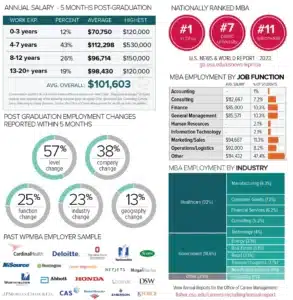
Many working professionals choose an online MBA to gain in-demand skills and management training that lead to career advancement. The Master of Business Administration degree can be a great way to grow your career, and the outcomes speak for themselves. The Max M. Fisher College of Business at The Ohio State University reports an average annual salary outcome of over $100,000 for graduates of their MBA for Working Professionals Program.

Career outcomes of MBA students from the Fisher College of Business.
Source: Fisher College of Business

But an MBA may not be the right choice for everyone. If you want to train in a very specific skillset or benefit from a curriculum adapted for your industry, you might want to consider other MBA alternatives.

Ohio State offers a wide variety of online master’s degrees to explore. Whether you want to try out a certificate before jumping into a full online master’s degree or are hoping to apply your education within a specific industry context, we may have the best MBA alternative for you.

Many of our 100% online master’s degrees are designed with working professionals in mind and offer flexible classes or requirements that can be completed on your own schedule.

Discover Ohio State’s online MBA alternatives by exploring the programs below, and reach out to us if you’d like to chat through your decision with an advisor.

MBA Alternatives from Fisher College of Business

If you’re not sure about an MBA but are still interested in a graduate-level business administration curriculum, Fisher College of Business has a few options.

Specialized Master in Business-Analytics: As the name implies, the specialized master’s degree from Fisher College of Business is designed for working professionals who want to focus their expertise in the area of business analytics. This MBA alternative equips students with an understanding of the science of data analytics and its implication for business innovation, productivity and growth.

Master of Supply Chain Management: The Master of Supply Chain Management is designed to address a critical workforce need, by preparing working professionals to become in-demand supply chain experts. This program includes three on-campus, personalized learning experiences such as workshops, on-site industry tours, executive speakers and in-person networking.

Law MBA Alternatives

If your work frequently intersects with legal, regulatory, or compliance-related issues – but you don’t need to become a practicing attorney – a master’s degree in legal studies may be the right MBA alternative for you. Students gain tools to interpret and apply the law in real-world settings, improving decision-making and leadership capacity in their organizations. Learn more about Ohio State’s law MBA alternative below.

Master in the Study of Law (MSL): Offered by the Moritz College of Law, this graduate degree is designed for professionals who need a solid understanding of the law to lead more effectively in industries like business, health care, human resources, technology, finance, and government. The MSL provides a deep, practical understanding of legal principles and regulatory frameworks – without requiring a JD or LSAT. You can tailor the program to your career goals with concentrations, including Business Law, Health Law, and Compliance, or personalize your degree with electives.

Business Law Graduate Certificate: Ohio State’s online business law certificate is a 12-credit, four-course program designed to provide professionals with practical expertise in areas like contract law, corporate governance, intellectual property, and compliance. It equips students to identify legal risks, interpret regulations, and apply legal concepts directly in the workplace. Plus, all credits can also be stacked toward the MSL program.

Public Administration MBA Alternatives

Are you more interested in a public service career? A public administration master’s degree might be the right choice for you. Much like an MBA, these programs often focus on finance, budgeting, management, and marketing skills – just within the realm of public service and non-profit roles (They’re even sometimes called the MBAs of the public sector!).

Master of Public Administration and Leadership: Offered by the John Glenn College of Public Affairs, this program is designed for mid-career professionals who seek leadership roles in the public sector, or for those who’d like to start their own non-profit. Throughout the program, students develop hands-on solutions to relevant public sector problems. They can also choose to specialize their education in an area that addresses workforce needs and builds on the strengths of Glenn faculty. The customizable nature of the curriculum and the expertise of the faculty makes the Master of Public Administration and Leadership a great MBA alternative for public service professionals.

Engineering MBA Alternatives

Engineers with aspirations of leadership in their teams or organization have two dedicated engineering MBA alternatives offered by the world-renowned College of Engineering at Ohio State.

Master of Engineering Management: Engineers who hope to lead teams and develop strategy in their roles may be interested in the online Master of Engineering Management (MEM) degree as an MBA alternative. This interdisciplinary program also draws coursework from Fisher College of Business and the John Glenn College of Public Affairs. Students will sharpen their engineering management expertise and gain a better understanding of policy and the business-government relationship.

Healthcare MBA Alternatives

For students with a healthcare background, business administration skills may represent a new learning opportunity and a chance to set themselves apart in their organizations. Online healthcare MBA alternatives at Ohio State include the Master of Healthcare Innovation – a broad healthcare administration master’s degree with a focus on leadership – and the M.S., Health-System Pharmacy Administration and Leadership, a program developed specifically for pharmacists.

Master of Healthcare Innovation: When you think about a healthcare MBA, you may think of a Master of Healthcare Administration (MHA). Like an MHA, the online Master of Healthcare Innovation at Ohio State trains students in concepts related to administration, healthcare technologies and patient care – but through the lens of innovation and advocacy.

M.S., Health-System Pharmacy Administration and Leadership: Another healthcare MBA option (tailored specifically for pharmacists) is the M.S., Health-System Pharmacy Administration and Leadership. This program is ideal for working pharmacists ready to advance into leadership roles. The program prepares students to manage the healthcare pharmacy enterprise with courses in finance, quality and safety and operations.

Master of Public Health – Program for Experienced Professionals: The College of Public Health’s MPH – Program for Experienced Professionals is a part-time program for aspiring public health and health care leaders. Its tailored curriculum provides essential skills in leadership, strategy, and planning to support health organizations. With an emphasis on population health management, the program prepares you to drive meaningful change in your community.

Choosing the right online master’s degree to advance your career can be a challenge, but the good news is you have plenty of options. Whether you decide to choose the online MBA route or consider one of our MBA alternatives, there’s a flexible online program at Ohio State that’s right for you.

What Can I Do with an Educational Technology Master’s Degree?

As technology is continually advancing and expanding access for students worldwide, it is critical for educators to stay up to date with the latest teaching tools and methods. The online Master of Learning Technologies (MLT) at Ohio State teaches educators how to conduct and apply research to better support learning with technology. An educational technology master’s degree can give you the tools to adapt to new situations, gain critical thinking skills, and resolve issues on your own. In addition, there are multiple career paths open to educators with this degree, such as:

  • Instructional Designer
  • Educational Technologist
  • Technology Integration Specialist

We spoke with a current student to learn more about her educational journey and how the online educational technology master’s degree has helped her grow her career. To learn more, reach out to us directly.

Allison Schultz, a current online Master of Learning Technologies student, is using her degree to build her competencies in instructional design and explore the ways individuals learn. Allison is currently an instructional design library liaison in the Office of Technology and Digital Innovation.

“I want to combine evidence-based instruction with my library background to help instructors develop information literacy skills in their students,” Schultz explained when asked what her goals were after graduation. Focusing on literacy is just one of the many uses of an educational technology master’s degree.

Allison also described how her time in the MLT program has given her a range of real-life skills that she has already gotten to use in her career. “I think the program’s emphasis on authentic, real-world application of learning technologies, will help me see connections between my work and educational experiences,” Schultz said.

“I think the program’s emphasis on authentic, real-world application of learning technologies, will help me see connections between my work and educational experiences.”
– Allison Schultz

Instructional Designer

One of the most common lines of work using an educational technology master’s degree is instructional design. So, what does an instructional designer do? These individuals are tasked with overseeing curriculums and teaching standards, often within higher education. They may be responsible for developing or redesigning courses, as well as other learning materials. According to the Bureau of Labor Statistics, instructional coordinator openings are expected to grow by 10% from 2020 to 2030. The BLS also said that the median pay for instructional coordinators in 2021 was $63,740.

Educational Technologist

Another option for students graduating with an educational technology master’s degree is to become an educational technologist. While instructional designers and educational technologists play similar roles, they can also have differences in their work. The main responsibilities of instructional designers are to design, manage, train, and provide support related to course development. In contrast, educational technologists focus on identifying, purchasing, and supporting technology and computer networks, as well as training instructors to use the technology.

Technology Integration Specialist

In addition, an educational technology master’s degree from Ohio State could land you a position as a technology integration specialist. In this role, individuals will often collaborate with educators to support, manage and optimize the use of software and network resources. Technology integration specialists work within the IT (Information Technology) team and must be able to work in a group as well as individually.

Obtaining an educational technology master’s degree can set you up to work in a variety of different fields and roles. If you’re interested in a career in educational technology, it is important to choose the right program. Ohio State’s online graduate education programs were ranked No. 28 in the country by U.S. News & World Report for our online Educational and Instructional Media Design specialty.

Want to learn more about this educational technology master’s degree? Contact us or visit our website for more information and we can help you on your journey.

Are Online Degrees Respected?

Whether you are busy raising kids, swamped with a full-time job, or cannot justify the commute to campus, there are many reasons why an online degree could be the right option for you. As the world around us is constantly changing, growing, and adjusting, college degrees are no exception. Where an in-person college experience was the norm in the past, online degrees and e-learning are becoming increasingly popular. However, many students are asking the same questions: Are online degrees respected? Are online degrees respected by employers as much as an on-campus degree?

Even though online degrees are much more common in current times, you might still be apprehensive about a new method of learning. Some students worry that there will be a disconnect between their professors and fellow classmates. Here at Ohio State, an online degree is an Ohio State degree. Your degree will be the same as if you were an on-campus student. And to reflect that, you receive the same level of support and quality of education as your on-campus counterparts.

How Do I Choose the Best Online Degree for My Career?

One way to find the correct program for you is to consider the program’s learning mode. Would you prefer fully asynchronous learning, or would you prefer a more hands-on approach with more interaction, such as in a synchronous program? In addition, doing research and thinking about your own education goals are necessary to find a college fit for you.

You can easily find rankings of the best online degrees across the country to give you more guidance on quality programs. For instance, U.S. News & World Report ranked Ohio State among the top 10 in the nation for many of its online bachelor’s programs. However, quality and cost are not the only elements that you will be comparing between programs. You should also look at the accreditation of the school, as well as whether you will be able to balance your workload with other responsibilities. While choosing a degree that is right for you can be intimidating, there are tips and tricks to narrow down your search.

Do Employers Respect Online Degrees?

In this era of online learning, more students are considering virtual options. Ohio State had 5,160 students enrolled in online programs in 2021. With the rising number of online students comes a rising number of employees hired with online degrees. However, do employers respect online degrees?

Ben Hazen is no newcomer when it comes to the world of online education. Ben received one of his three master’s degrees fully online. He now teaches an online MBA course at Mississippi State University, is a visiting professor at the University of Dayton, and is also the Chief Integration Officer at PW Communications. In addition, Ben was a sponsor of one of the first capstone projects for the online Master of Translational Data Analytics program here at Ohio State.

“In reality, it really depends on the school and the type of degree,” Ben stated about the quality of online degrees. He also emphasized pairing your online degrees with other credentials or experiences, which will stand out to employers. Ben mentioned that he has never had any trouble finding a job with his online degree and that many times, hiring managers did not realize that his degree was obtained fully online.

How to List an Online Degree on a Resume

Creating a resume can be overwhelming, and you may not know how to list your online degree properly. However, Master of Learning Technologies student Elizabeth Trolli says it’s simple: Market your online degree just like an on-campus degree. Instead of focusing on the listing of an online degree on your resume, highlight the skills you have obtained from online learning during the interview process.

“The focus should be more on how you were able to integrate your concepts and learning into your position or leverage that into your career and possible career advancements,” Elizabeth stated. If you need help finding a starting point, Ohio State offers many resume guides.

Can You Get a Job with an Online Degree?

In short, yes! You can absolutely get a job using an online degree. Some aspects may heighten your chances of receiving your dream position, such as the accreditation of the college, student success rates, faculty credentials, as well as if they are affiliated with a brick-and-mortar campus, and more. Luckily, Ohio State excels at all these characteristics. As an accredited, non-profit, brick-and-mortar college with a large portfolio of online programs, Ohio State produces some of the most highly sought-after graduates, according to a survey by Times Higher Education. Overall, employers will be less concerned with how you earned your degree and more concerned with where. Depending on the school you attended, an online degree can absolutely be respected and accepted by employers. Earning an online degree shows time management skills, work ethic, and a desire to better yourself, which are all valuable strengths to take into the workplace.

What Can You Do With a Public Administration Master’s Degree?

The public sector is on the cusp of significant transformation. The “Baby Boomer” generation, born between 1946 and 1964, is rapidly approaching retirement age, and this demographic shift will create a surge of opportunities, with an estimated 4 million boomers leaving the workforce each year. As boomers hold a significant portion of public sector jobs and fill many leadership positions, the need for qualified professionals to fill these vacancies is critical upon their retirement. Now more than ever professionals need to prepare themselves to fill those roles and step into leadership positions. A public administration master’s degree is an increasingly popular option that allows you to grow your professional knowledge to excel in your career or make a career change.

What is a Master of Public Administration?

A Master of Public Administration (MPA) equips you with the knowledge and skills to excel in public service careers. The program is designed for recent college graduates or early-career professionals to provide a strong foundation in public policy, economics, management, and data analysis, preparing you for a wide range of positions. Occupations for this degree are broad and encompass many disciplines, from administration, management, and budget analyst roles across government and non-profit industries. Within this program you can earn your MPA full time in as little as two years, or three years part-time as a working professional to grow skills and lead change within your current organization. During your second year, you can tailor your coursework through skill courses, electives, and a capstone.

“The online modality of the MPA will allow students flexibility in both location and their schedule. Our MPA is a long-standing program with full accreditation and a high ranking both by U.S. News and World Report and Shanghai Rankings, and our online students will have access to the same high-quality instruction and faculty members. As a Glenn College alum, you will also have access to the large alumni network around the country, which will help you with new career and professional opportunities.” says Lindsey Lee, the graduate program manager at the John Glenn College of Public Affairs.

What is a Master of Public Administration and Leadership?

A Master of Public Administration and Leadership (MPAL) is essentially an executive MPA degree, created specifically for mid-career professionals who have least 3 years of administrative or analytical post-baccalaureate experience, who are seeking the skillsets needed to assume leadership roles.

“Because students are coming in with work experience, the expectation is that they are able to use that experience and go deeper in the course assignments,” said Mindy Niehaus, the MPAL Program Manager.

The MPAL program courses are 100% online and designed to be completed asynchronously, allowing you to continue full-time employment while participating in the program. You are expected to meet synchronously on Zoom only a handful of times, giving you the flexibility to schedule coursework around your current job.

This public administration master’s degree can be completed in five semesters, with the ability to take more time to complete the program if needed. The integrated curriculum targets the needs of working professionals in both the public and nonprofit sectors.

Additionally, you can specialize in an area that aligns with your career goals with instruction from Glenn College faculty and practitioner instructors. Specializations include:

  • Public Management
  • Public Policy
  • Criminal Justice Administration and Policy
  • Nonprofit Management

Students of the MPAL program come from diverse personal and professional backgrounds, allowing you to learn from one another. Current students have occupations ranging from HR Consultant, Outreach Coordinator, Firefighter, Attorney and Research Assistant.

“You are able to look at a problem or issue and see it from multiple perspectives,” said Niehaus. “As opposed to a traditional class where you just learn from the instructor, students are encouraged to bring their experience to class and learn from one another.”

How does a master’s degree prepare you for public administration jobs?

During the MPA and MPAL program, you will address real-world problems. The programs integrate a focus on ethical leadership, civic engagement, civic discourse and diversity in each course.

Ohio State faculty members intentionally designed the curriculum by talking to employers directly about what they look for in employees so that students receive applicable hands-on skills.

Our capstone course challenges students to apply their knowledge to real-world public policy or management challenges. Through in-depth analysis and problem-solving, you’ll demonstrate your ability to synthesize complex information and develop practical solutions.

What kinds of jobs can you get with a Public Administration master’s degree?

A public administration master’s degree allows you to advance in your current position or obtain the skills necessary to switch fields entirely. Essentially, an MPA is an MBA for the public sector. Public administration graduates may go on to become:

  • Public Relations Managers
  • Program Managers
  • Operations Managers
  • Chief Executives
  • Regulatory Affairs Managers
  • Technical Project Managers
  • Directors of Social Services
  • Social and Community Service Managers

In May 2023, the median annual wage for public relations managers within the government was $115,750.

In order to reach your personal and professional mission, you are consistently supported by Ohio State’s world-class faculty, academic advisors, and career specialists during your program and beyond as a buckeye alumnus.

Not sure if you are ready to start a master’s program or want to have a more competitive application for graduate school?

Ohio State offers three online graduate certificate programs which are all 100% online and earned credits are transferrable into both the MPA and MPAL program. To apply to these programs, you must have completed your bachelor’s degree:

Ready to take the next step?

See how you can serve your community in new, transformative ways. If you have questions or need help getting started, complete our intake form with your contact information. An Ohio State Online Enrollment Advisor will reach out to provide personalized guidance, walk you through the application process, and support you every step of the way. 

Ready to take the next step?

See how you can serve your community in new, transformative ways. If you have questions or need help getting started, complete our intake form with your contact information. An Ohio State Online Enrollment Advisor will reach out to provide personalized guidance, walk you through the application process, and support you every step of the way.